Skinwalker Ranch: America's Most Studied Paranormal Hotspot
For 30 years, Utah's Skinwalker Ranch has produced reports of UFOs, cattle mutilations, and glowing orbs. Here's what we know and what science hasn't proven.
In the spring of 1994, Terry and Gwen Sherman moved their family to a 512-acre cattle ranch in Utah's Uinta Basin. The property was quiet, remote, surrounded by desert mesas and scrubland. It seemed like a good place to raise cattle. Within eighteen months, they'd sell it and leave, driven out by experiences they couldn't explain and didn't want to keep living through.
What the Shermans described on that ranch reads like a checklist of every paranormal claim you've ever heard: UFOs, glowing orbs, cattle found surgically mutilated without a drop of blood, enormous wolf-like creatures impervious to bullets, crop circles, poltergeist activity, and strange lights moving through the sky. It sounds absurd. And yet, the U.S. government would eventually spend $22 million investigating phenomena connected to this property.
Welcome to Skinwalker Ranch, the most studied, most debated, and possibly most overhyped piece of paranormal real estate in the world.
What You'll Learn
- •Where Is Skinwalker Ranch?
- •What Did the Sherman Family Experience?
- •The Bigelow Era: Scientific Investigation
- •The Pentagon Connection: $22 Million in Government Funding
- •Brandon Fugal and the History Channel
- •What Types of Phenomena Have Been Reported?
- •The Case for Caution
- •The Believers' Case: Why Some Researchers Take It Seriously
- •Ute Tribal Connections and the Skinwalker Legend
- •Where Things Stand Today
- •Frequently Asked Questions
Where Is Skinwalker Ranch?
Skinwalker Ranch sits in Uintah County, in northeastern Utah, just southeast of the small community of Ballard. It borders the Uintah and Ouray Indian Reservation, homeland of the Ute tribe. The Uinta Basin is a wide, semi-arid valley bounded by the Uinta Mountains to the north and the Tavaputs Plateau to the south.
The region has a longer history of UFO reports than most people realize. Local newspapers documented sightings in the Uinta Basin as early as the 1970s. The Deseret News ran one of the first major stories about unusual activity on the ranch in June 1996, and investigative journalist George Knapp later published a detailed series in the Las Vegas Mercury.
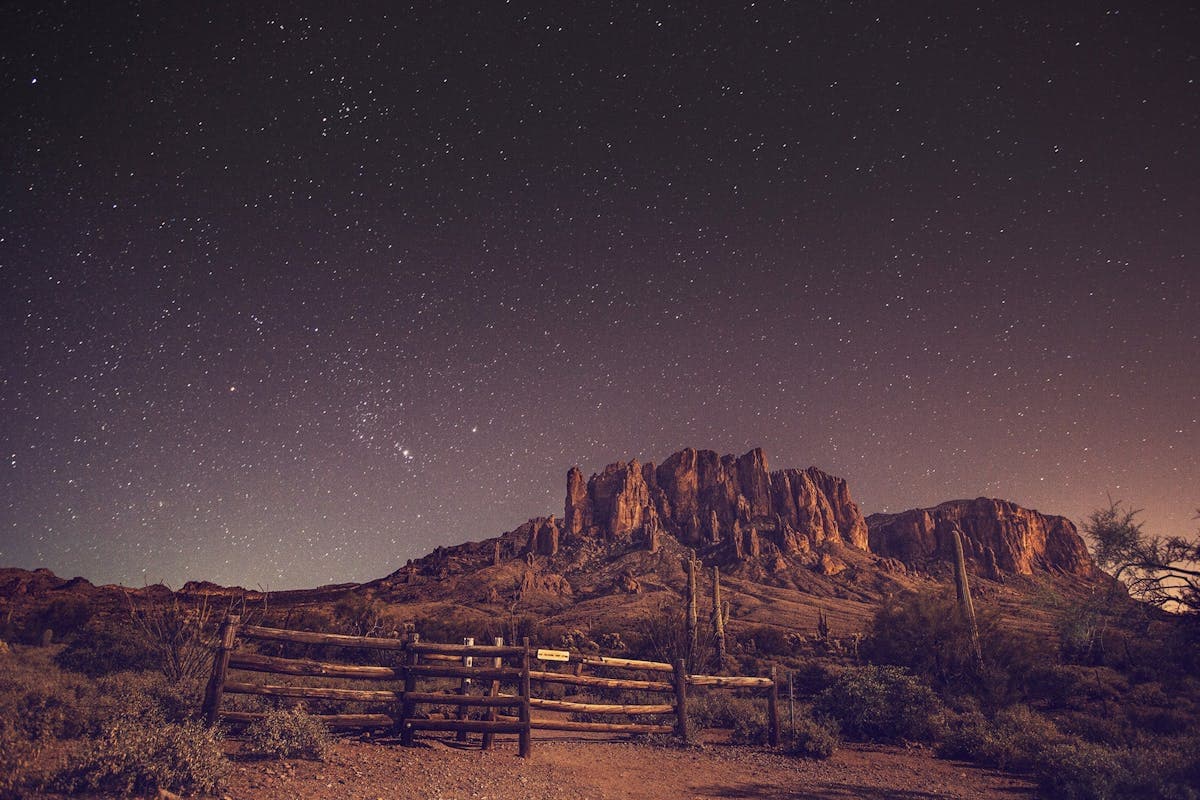
The ranch itself is unremarkable to look at. It's scrubby ranch land with a few structures, some fencing, and a prominent mesa that's become central to later investigations. What makes it unusual, supposedly, is what happens there after dark.
What Did the Sherman Family Experience?
Terry and Gwen Sherman purchased the ranch in 1994. According to their accounts, shared with reporter Zack Van Eyck of the Deseret News, the trouble started almost immediately.
The first incident reportedly involved an enormous wolf. Terry Sherman said the animal approached the family in broad daylight, acting tame enough for Gwen to touch it. When it grabbed a calf through the corral bars, Terry shot it with a .357 Magnum at close range. The wolf didn't react. He shot it again. And again. After multiple hits from both a revolver and a rifle, the animal reportedly walked away uninjured, leaving tracks that simply stopped in the mud.
Over the following months, the Shermans reported:
- •Cattle mutilations: Animals found dead with surgical precision. Organs removed, no blood on the ground, no tracks around the carcasses.
- •UFOs and orbs: Strange lights in the sky, including what they described as a large, silent craft and smaller glowing orbs that moved with apparent intelligence.
- •Crop circles: Circular impressions appearing in the grass overnight.
- •Poltergeist activity: Objects moved in the house, equipment malfunctioned.
- •Large, unknown animals: Besides the bulletproof wolf, the family reported seeing other creatures they couldn't identify.
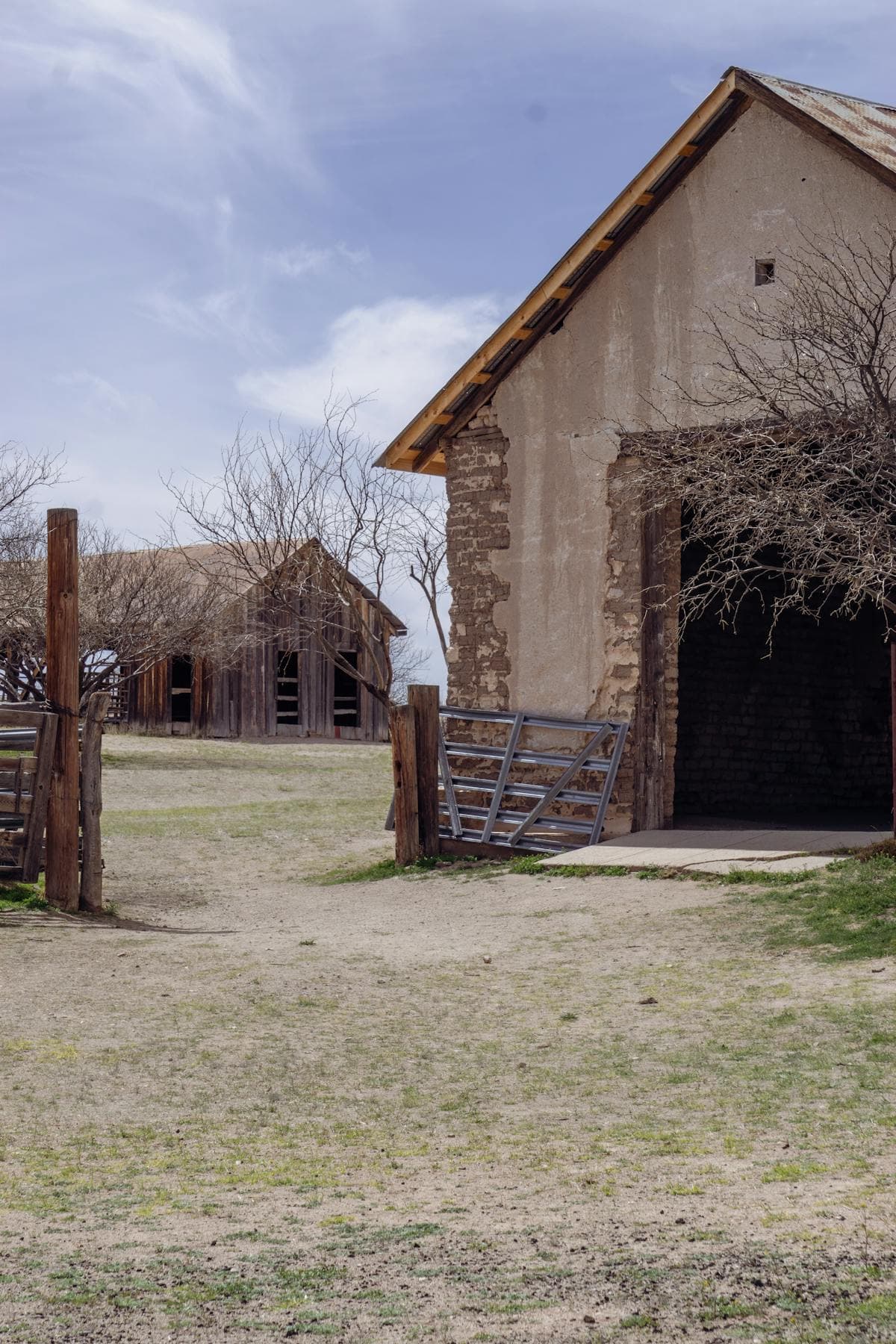
The Shermans lost cattle, they said, either to mutilation or outright disappearance. One account describes a cow vanishing from a field in broad daylight, leaving tracks that stopped abruptly. By 1996, the family had had enough and put the property up for sale.
It's worth noting that the previous owners, Kenneth and Edith Myers, lived on the property for 60 years before the Shermans. They reported nothing unusual.
The Bigelow Era: Scientific Investigation
Robert Bigelow, a Las Vegas real estate billionaire with a well-known interest in paranormal research, bought the ranch in 1996 for $200,000. Bigelow had founded the National Institute for Discovery Science (NIDSci), and he intended to apply rigorous scientific methods to the ranch's alleged phenomena.
NIDSci installed surveillance cameras, motion sensors, and other monitoring equipment across the property. They stationed researchers on-site. Retired U.S. Army Colonel John B. Alexander was among those involved, and he described the effort as a "standard scientific approach" to collecting hard data.
The results were, to put it diplomatically, frustrating.
According to Colm Kelleher, a biochemist who led the NIDSci investigation and later co-authored the 2005 book "Hunt for the Skinwalker" with George Knapp, researchers observed or investigated close to 100 incidents. These ranged from sightings of unidentified objects to encounters with animals that didn't behave like any known species to equipment failures that seemed deliberately targeted.
But here's the critical part: they couldn't prove any of it.
Kelleher himself admitted to "difficulty obtaining evidence consistent with scientific publication." Cameras would malfunction at key moments. Equipment would fail precisely when phenomena were reported. One famous account describes researchers watching an event unfold, only to discover that every recording device in range had stopped working.
The phenomena seemed, as Kelleher described it, almost aware of being observed. It responded to investigation by becoming harder to document.
The Pentagon Connection: $22 Million in Government Funding
The story takes its strangest turn in 2007. James Lacatski, an official with the Defense Intelligence Agency (DIA), read Kelleher and Knapp's book and contacted Bigelow for permission to visit the ranch. According to multiple sources, including a detailed New Yorker investigation, Lacatski had what he described as a supernatural experience during his visit.
Lacatski brought his experience to Senator Harry Reid of Nevada, who was already friendly with Bigelow. Reid and Senator Ted Stevens (who himself claimed to have had a UFO encounter) arranged for $22 million to be inserted into the Department of Defense budget, creating what became known as the Advanced Aerospace Threat Identification Program (AATIP), later called the Advanced Aerospace Weapon System Applications Program (AAWSAP).
A significant portion of that funding went to Bigelow's company, Bigelow Aerospace Advanced Space Studies (BAASS), for continued research at the ranch and related investigations.
This is the part that makes skeptics particularly uneasy: taxpayer money, funneled through defense channels, going to study a property whose primary evidence was anecdotal. Barry Greenwood, a respected ufologist, wrote in the Journal of Scientific Exploration in 2023 that the research program produced no documentary evidence and characterized Skinwalker as "always in the business of selling belief and hope."
Brandon Fugal and the History Channel
In 2016, Bigelow sold the ranch to Brandon Fugal, a Utah real estate developer and tech investor, for approximately $500,000 through a shell company called Adamantium Real Estate LLC. Fugal initially remained anonymous but revealed his ownership in March 2020.
Under Fugal's ownership, the ranch became the subject of "The Secret of Skinwalker Ranch," a History Channel reality series that premiered in 2020. The show follows a team using ground-penetrating radar, drone thermography, lasers, and other technology to investigate the property. It's produced by the same team behind "The Curse of Oak Island," another long-running mystery investigation series.
The show has reported anomalies including GPS interference, unusual radio frequencies, unidentified aerial phenomena captured on camera, and readings from the mesa that don't match expected geological patterns.
Fugal also trademarked "Skinwalker Ranch" in 2017, with the mark covering recreation facilities, multimedia content, motion pictures, and television shows. A 2021 filing expanded the trademark to merchandise including cups, mugs, shirts, and hats.
This commercial angle hasn't gone unnoticed by critics.
What Types of Phenomena Have Been Reported?
Across three decades of ownership changes and investigations, the reported phenomena at Skinwalker Ranch generally fall into several categories:
UFOs and Aerial Phenomena: Witnesses have described everything from small glowing orbs to large, structured craft. These are among the most commonly reported incidents, going back to regional UFO sightings documented in the 1970s.
Cattle Mutilations: A persistent theme, consistent with a broader pattern of cattle mutilation reports across the western United States dating back to the 1960s. The mutilations are described as surgically precise, bloodless, and unexplained by predator activity.
Cryptid Encounters: The bulletproof wolf is the most famous, but there have also been reports of Bigfoot-like creatures and other unidentifiable animals. The ranch's name comes from the Navajo skinwalker legend, though the property is actually on Ute, not Navajo, territory.
Electromagnetic Anomalies: Equipment failures, GPS glitches, and unusual radiation readings have been reported by multiple investigation teams.
Poltergeist Activity: Objects moving, doors opening, and general disturbances inside structures on the property.
The Case for Caution
The frustration with Skinwalker Ranch has always been the gap between what witnesses describe and what can be verified. But absence of proof isn't proof of absence — especially in a place where equipment seems to malfunction at the worst possible moments.
No reproducible evidence after 30 years. Despite millions of dollars in funding, professional scientific teams, government involvement, and a television show with a dedicated crew, not a single piece of evidence from Skinwalker Ranch has been published in a peer-reviewed scientific journal. NIDSci admitted this. The Pentagon program produced no public documentation of confirmed anomalies.
The Myers family saw nothing. Kenneth and Edith Myers lived on the property for 60 years before the Shermans. They reported zero supernatural events. Skeptic Robert Sheaffer considers this the strongest argument against the ranch's reputation, suggesting the Shermans may have invented or exaggerated their experiences. As Sheaffer wrote for Skeptic Magazine, the simplest explanation is that the Shermans fabricated the story "prior to selling it to the gullible Bigelow."
Terry Sherman stayed on as caretaker. After selling to Bigelow, Sherman remained on the property as a paid caretaker. Many of the most dramatic reported incidents originated from Sherman's accounts. This raises questions about the independence of the testimony.
The "elusive evidence" problem. The claim that phenomena intensify when being observed but can't be recorded is, from a scientific standpoint, unfalsifiable. If evidence can never be captured, the claim can never be disproven, which makes it untestable rather than mysterious.
Commercial incentives. The trademarking and merchandising of "Skinwalker Ranch" as a brand, combined with a lucrative television deal, creates financial motivation to keep the mystery alive. James Randi awarded Bigelow a tongue-in-cheek Pigasus Award in 1996 for "the funding organization that supported the most useless study of a supernatural claim."
The Believers' Case: Why Some Researchers Take It Seriously
Despite the skeptical arguments, some researchers believe there's something genuinely unusual happening at the ranch, even if it hasn't been proven.
Volume and consistency of reports. The sheer number of reported incidents, spanning multiple owners and investigation teams, is unusual. While individual claims are easy to dismiss, the pattern across decades is harder to write off entirely.
Credible observers. Not everyone reporting anomalies is a rancher or television personality. The NIDSci team included PhD scientists and a retired Army colonel. Defense Intelligence Agency officials visited and were apparently convinced enough to push for federal funding.
Regional context. The Uinta Basin has UFO reports going back to the 1970s, well before the ranch became famous. The broader area, not just the ranch itself, has a history of unusual sightings. The Rendlesham Forest incident in England shows that military personnel can witness phenomena they can't explain, even in officially documented cases.
Genuine measurement anomalies. Some of the readings from the History Channel investigations, particularly radio frequency anomalies and ground-penetrating radar results from the mesa, appear to show genuinely unusual patterns. Whether they're "paranormal" or simply unexplained geology is an open question.
The government took it seriously. You don't have to believe in UFOs to find it significant that $22 million in defense funding was directed at this question. That doesn't prove anything supernatural, but it suggests that people in positions of authority and with access to classified information found the topic worthy of investigation.
Ute Tribal Connections and the Skinwalker Legend
The ranch's name references the Navajo skinwalker, a shape-shifting witch from Navajo tradition. However, the property actually borders Ute territory, not Navajo. The Ute people have their own traditions about the land, and by most accounts, they've long considered the area spiritually significant and potentially dangerous.
Local Ute oral tradition reportedly holds that the Uinta Basin is a place where dark forces reside. Some accounts describe it as land "cursed" by the Navajo as retribution against the Ute. Whether this represents genuine ancient tradition or a more recent narrative shaped by the ranch's fame is debated.
What's clear is that the indigenous perspective on this land predates the Shermans, Bigelow, Fugal, and the History Channel by generations. The Ute relationship with this landscape carries cultural weight that the paranormal investigation industry doesn't always treat with appropriate respect.
The broader tradition of skinwalkers in Navajo culture is considered sacred and not something most Navajo people discuss publicly. Using the term for a television franchise and merchandise line has drawn criticism from indigenous communities.
Where Things Stand Today
Skinwalker Ranch remains privately owned by Brandon Fugal. "The Secret of Skinwalker Ranch" continues to air on the History Channel. The property is not open to the public, surrounded by cameras and barbed wire, with posted warnings against trespassing.
No definitive evidence of paranormal activity has been produced. No peer-reviewed paper has confirmed supernatural events at the ranch. But no investigation has conclusively explained what the Shermans experienced, either, assuming they experienced it at all.
The ranch sits in a strange middle ground. It's either the most important paranormal location on Earth, a property where the laws of physics break down in measurable ways, or it's a decades-long chain of exaggeration, misidentification, and commercial exploitation that snowballed from one family's claims into a multimillion-dollar enterprise.
The honest answer is: we don't know. And the ranch seems determined to keep it that way.
If the intersection of government secrecy and unexplained aerial phenomena interests you, check out the Rendlesham Forest incident, sometimes called "Britain's Roswell." And for another case where massive investigation hasn't produced answers, the Oak Island Money Pit shares Skinwalker's DNA of endless searching and elusive proof. The broader question of what's out there connects to the Wow! Signal, a burst of radio energy from space that still hasn't been explained.
Frequently Asked Questions
Can you visit Skinwalker Ranch?
No. The ranch is private property, and Brandon Fugal has made it clear that trespassing isn't tolerated. The perimeter is monitored by cameras and security systems, and signs warn against unauthorized entry. The closest most people can get is watching the History Channel series or viewing it from public roads at a distance.
Has anyone died at Skinwalker Ranch?
There are no confirmed deaths linked to paranormal activity at the ranch. Some accounts describe health effects experienced by researchers, including nausea, disorientation, and unexplained illnesses, but no fatalities have been documented. The Shermans reported losing cattle, not people.
Did the U.S. government really spend $22 million studying Skinwalker Ranch?
Yes, though the funding was broader than just the ranch. Senators Harry Reid and Ted Stevens arranged for $22 million in Defense Department funding for the Advanced Aerospace Weapon System Applications Program (AAWSAP). A significant portion went to Bigelow Aerospace Advanced Space Studies. The program studied unidentified aerial phenomena more broadly, with Skinwalker Ranch as one focal point.
Why is it called Skinwalker Ranch if it's on Ute land, not Navajo?
The name was popularized by Colm Kelleher and George Knapp's 2005 book "Hunt for the Skinwalker." While the skinwalker is a Navajo concept, some local traditions describe a Navajo curse placed on the Ute and their lands. The name stuck because of its marketability and connection to shape-shifting legends, even though the cultural attribution isn't entirely accurate.
What's the strongest evidence from Skinwalker Ranch?
That depends on who you ask. Believers point to the government's willingness to fund research, the consistency of reports across multiple owners, and measurement anomalies documented on the History Channel show. Others suggest that after 30 years and millions of dollars, there's no peer-reviewed evidence, no reproducible data, and no physical proof. The strongest "evidence" might be the sheer volume of claims, but volume alone doesn't equal proof.
Want to explore more mysteries?
We've got plenty more rabbit holes to go down.