The Wow! Signal: 72 Seconds That Changed the Search for Alien Life
In 1977, a radio telescope detected a powerful 72-second signal from deep space. It's never repeated. Explore the theories behind the Wow! Signal and why it still matters.
On August 15, 1977, at 11:16 PM Eastern time, a radio telescope in rural Ohio picked up something it shouldn't have. The Big Ear radio telescope at Ohio State University was scanning the skies as part of the longest-running search for extraterrestrial intelligence in history. It had been doing this for four years without detecting anything unusual.
Then, for exactly 72 seconds, it recorded a radio signal 30 times stronger than the background noise of deep space. The signal came from the direction of the constellation Sagittarius. It was broadcast on a frequency of approximately 1420 MHz, the exact frequency naturally emitted by hydrogen, the most common element in the universe, and the frequency that scientists had theorized an alien civilization would by one account use to communicate.
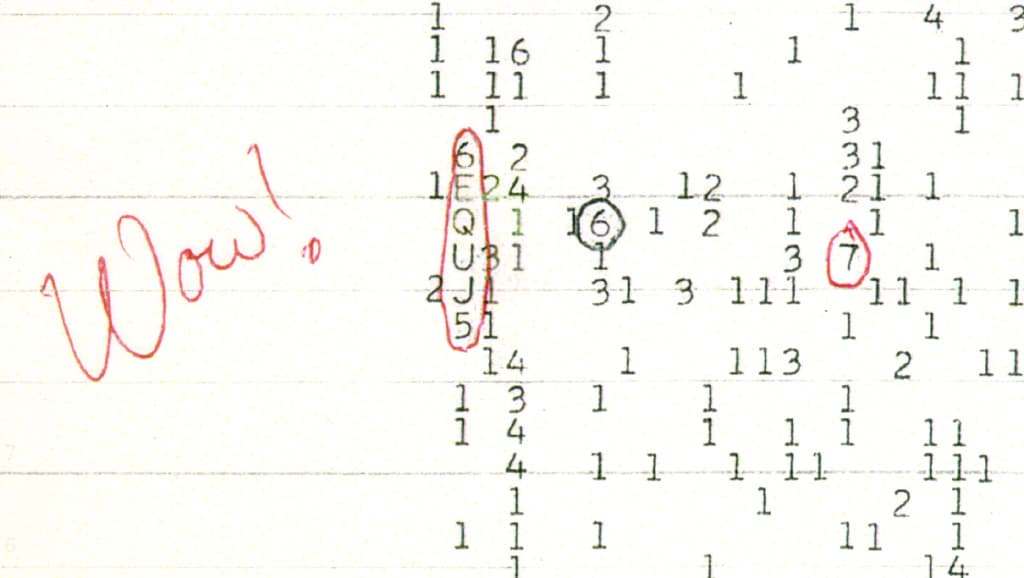
A few days later, volunteer astronomer Jerry Ehman was reviewing the printed data when he spotted the anomaly. Next to the string of characters representing the signal's intensity, "6EQUJ5," he wrote a single word in red ink: "Wow!"
The Wow! Signal has never repeated. Nearly five decades of follow-up searches have found nothing. It remains SETI's greatest puzzle and one of the most tantalizing hints that we might not be alone.
What You'll Learn
- •How Was the Wow! Signal Detected?
- •What Does "6EQUJ5" Mean?
- •Why Is the Hydrogen Line So Important?
- •Why Did the Signal Last Exactly 72 Seconds?
- •Has Anyone Tried to Find It Again?
- •Could It Have Been a Comet?
- •The Hydrogen Cloud Superradiance Theory
- •Could It Really Be Aliens?
- •Why Does the Wow! Signal Still Matter?
- •Frequently Asked Questions
How Was the Wow! Signal Detected?
The Big Ear radio telescope wasn't a dish you'd recognize from the movies. It was a flat, ground-based antenna array at Ohio State University's radio observatory near Delaware, Ohio, roughly 25 miles north of Columbus. The telescope worked by scanning the sky as the Earth rotated, listening for radio signals across 50 frequency channels simultaneously.

The observatory had been reassigned to SETI work in 1973, after completing an extensive survey of extragalactic radio sources. For four years, it quietly listened. The data was processed by an IBM 1130 computer and printed on continuous paper, which volunteers like Ehman reviewed by hand.
The telescope's design meant it could observe any particular point in the sky for exactly 72 seconds as the Earth's rotation carried that point across the telescope's field of view. If a signal from a fixed point in space were detected, it would follow a specific intensity pattern: gradually strengthening as the source entered the beam, peaking when centered, then gradually weakening as it passed out of view.
The Wow! Signal followed this pattern perfectly. It strengthened, peaked, and faded in exactly the way a signal from a fixed extraterrestrial source would. This was one of the first things that made it remarkable: whatever it was, it behaved like something out there in space, not like terrestrial interference.
What Does "6EQUJ5" Mean?
The string "6EQUJ5" is frequently misinterpreted as a coded message. It isn't. It's simply the signal's intensity over time, recorded in the measuring system the Big Ear used.
The system represented signal-to-noise ratio with single characters. A blank space meant baseline noise (0-1 standard deviations above background). Numbers 1 through 9 represented their corresponding intensity levels. For values of 10 and above, the system switched to letters: A = 10-11, B = 11-12, and so on.
The "U" in the sequence represents an intensity between 30 and 31 standard deviations above the noise floor. That's extraordinarily strong. For context, most natural radio sources in the sky don't even register as a blip on this scale.
Reading "6EQUJ5" as a timeline: the signal ramped up (6, E, Q, U), peaked at U, then fell off (J, 5). This is exactly the profile you'd expect from a distant point source passing through the telescope's beam as the Earth rotated.
Why Is the Hydrogen Line So Important?
In 1959, Cornell University physicists Philip Morrison and Giuseppe Cocconi published a landmark paper arguing that any civilization attempting interstellar communication would likely choose a frequency of 1420 MHz. This is the emission frequency of neutral hydrogen, the hydrogen line (or 21-centimeter line).
Their reasoning was elegant: hydrogen is the most abundant element in the universe. Any technologically advanced civilization would know about the hydrogen line. It's a natural "meeting point" on the electromagnetic spectrum, a frequency that any species capable of radio astronomy would be familiar with.

Additionally, the 1420 MHz band is relatively quiet in terms of natural interference. On Earth, it's internationally protected from human transmissions specifically because of its scientific importance.
The Wow! Signal was detected at approximately 1420.4556 MHz, just slightly above the hydrogen line's rest frequency of 1420.4058 MHz. The slight offset could represent a blue-shift (meaning the source was moving toward Earth at roughly 10 km/s) or could simply be a measurement artifact.
The fact that this signal appeared at the one frequency SETI scientists had been saying for nearly two decades an alien civilization would by one account use is either an extraordinary coincidence or exactly what you'd expect if someone out there was trying to get our attention.
Why Did the Signal Last Exactly 72 Seconds?
This is a question that sounds mysterious but has a straightforward answer. The signal lasted 72 seconds because that's how long the Big Ear could observe any single point in the sky. The telescope didn't track objects; it relied on the Earth's rotation to sweep its beam across the sky.
If the signal source was continuously broadcasting, the Big Ear would only have heard it during the 72-second window when its beam passed over that part of the sky. The signal's duration matches this window exactly, meaning the actual broadcast could have been going on much longer. We just happened to catch 72 seconds of it.
This is actually an important piece of evidence. If the signal had been significantly shorter than 72 seconds, it could have been a transient event like a satellite reflection or electrical interference. The fact that it filled the entire observation window strongly suggests it came from a fixed point in the sky.
Has Anyone Tried to Find It Again?
Dozens of times. Nobody's found it.
Ehman himself searched for the signal repeatedly in the months and years following the detection, pointing the Big Ear at the same coordinates. Nothing. Robert Gray, an amateur astronomer who became obsessed with the case, searched for the signal using the 26-meter radio telescope at the Harvard/Smithsonian Oak Ridge Observatory in 1995 and 1996, then again using the Very Large Array (VLA) in New Mexico in 1999. All attempts came up empty.

In 2012, on the 35th anniversary of the detection, the Arecibo Observatory beamed a collection of crowd-sourced messages toward the Wow! Signal's coordinates. It was more symbolic than scientific, but it reflected the enduring public fascination with the event.
The failure to redetect the signal has been used both for and against the extraterrestrial hypothesis. Critics say a genuine alien transmission would likely repeat. Supporters counter that a civilization might send brief, non-repeating signals, or might have moved on, or might be broadcasting in a pattern we haven't figured out yet.
Could It Have Been a Comet?
In 2016, astronomer Antonio Paris proposed that the Wow! Signal was caused by hydrogen gas streaming off a comet that happened to be in the signal's line of sight. Specifically, he pointed to two comets, 266P/Christensen and P/2008 Y2 (Gibbs), which were in the general area of the sky at the time.
Paris published observations in 2017 claiming he'd detected a similar signal from 266P/Christensen. The paper generated significant media coverage.
However, the comet hypothesis was met with widespread skepticism from the scientific community:
- •Signal strength: Comets don't produce radio emissions anywhere near the intensity of the Wow! Signal. The signal was 30 standard deviations above background noise. A comet's hydrogen emission would be orders of magnitude weaker.
- •Narrowband characteristics: The Wow! Signal was extremely narrowband, consistent with an artificial transmission. Comet emissions are broadband.
- •Location precision: Subsequent analysis suggested the comets weren't precisely in the signal's beam at the right time.
- •SETI's response: Seth Shostak of the SETI Institute and others criticized the methodology of Paris's observations.
Most astronomers consider the comet theory effectively debunked, though Paris maintains his position.
The Hydrogen Cloud Superradiance Theory
In 2025, a new explanation emerged that many scientists find more compelling than the comet hypothesis.
Researchers analyzing data from the Arecibo REDS (Radio Emissions from Red Dwarf Stars) survey found evidence of signals that, while much weaker than the Wow! Signal, shared similar characteristics. These signals appeared to come from clouds of neutral hydrogen in interstellar space.
The key mechanism they proposed is "superradiance," a quantum optical process in which atoms in a gas cloud can spontaneously synchronize their emissions, producing a burst of radiation far more intense than the individual atoms could generate alone. It's similar to how a laser works, but occurring naturally in hydrogen clouds under specific conditions.
If a hydrogen cloud underwent superradiance in the direction of the Big Ear at just the right moment, it could theoretically produce a signal matching the Wow! Signal's characteristics: narrowband, at the hydrogen line frequency, extremely strong, and transient (occurring only once as conditions aligned).
This theory is still being evaluated by the scientific community. It offers a natural explanation that doesn't require the signal to have been artificial, but the conditions required for such an event would be extremely rare, which could explain why the signal has never been detected again.
Could It Really Be Aliens?
Let's be honest about what we know and don't know.
What the Wow! Signal is consistent with:
- •A deliberate transmission from an extraterrestrial civilization broadcasting on the hydrogen line
- •An extremely rare natural astrophysical event (like hydrogen cloud superradiance)
- •An unknown terrestrial or near-Earth source that hasn't been identified
What the Wow! Signal is NOT consistent with:
- •Known satellite transmissions (the frequency is protected from human use)
- •Aircraft or terrestrial radio interference (the intensity profile matches a deep-space point source)
- •Comets (too weak by orders of magnitude)
- •Equipment malfunction (the signal's characteristics are too specific and consistent)

The signal matches what SETI scientists predicted an alien transmission would look like: narrowband, at the hydrogen frequency, from a fixed point in space. But a single, non-repeating detection isn't enough to confirm extraterrestrial origin. In science, reproducibility matters, and this signal has stubbornly refused to reproduce.
Jerry Ehman himself remained cautious throughout his life. He said the signal was "something that should not exist" but stopped short of claiming it was alien. "I should have written 'Interesting!'" he once joked about his famous margin note.
Why Does the Wow! Signal Still Matter?
Nearly 50 years later, the Wow! Signal remains important for several reasons.
It demonstrated that SETI could work. Before August 15, 1977, searching for alien signals was largely theoretical. The Wow! Signal showed that radio telescopes could detect anomalous signals that didn't match any known natural or human-made source.
It set the standard for what a genuine extraterrestrial signal might look like. Every SETI program since has used the Wow! Signal's characteristics as a benchmark.
It highlighted the limitations of our search. The Big Ear could only observe one narrow strip of sky at a time. If the signal repeated while the telescope was pointed elsewhere, it would have been missed. The vast majority of the sky, at all times, goes unmonitored.
And it gave humanity something powerful: a single data point suggesting that the universe might not be silent after all. Not proof. Not confirmation. Just a hint, 72 seconds long, that something out there might be worth listening for.
For more on unexplained signals and space anomalies, explore the Baltic Sea Anomaly, an unusual formation detected on the ocean floor. Cicada 3301 offers a different kind of signal mystery, one broadcast deliberately on the internet rather than from deep space. And the Bermuda Triangle demonstrates how unexplained phenomena can capture the public imagination for generations.
Frequently Asked Questions
What was the Wow! Signal?
It was a strong narrowband radio signal detected on August 15, 1977, by Ohio State University's Big Ear radio telescope. The signal lasted 72 seconds, came from the direction of the constellation Sagittarius, and was broadcast near the frequency of neutral hydrogen (1420 MHz). Astronomer Jerry Ehman wrote "Wow!" next to the data, giving it its name.
Has the Wow! Signal ever been detected again?
No. Despite dozens of follow-up searches using multiple telescopes, including the Very Large Array and the Harvard/Smithsonian Observatory, the signal has never recurred. Its one-time nature remains one of the most puzzling aspects of the case.
Was the Wow! Signal caused by a comet?
Astronomer Antonio Paris proposed this theory in 2016, but it's been widely rejected by the scientific community. Comets don't produce radio emissions strong enough to match the Wow! Signal's intensity, and their emissions are broadband rather than narrowband.
What does "6EQUJ5" mean?
It's not a message. It's a representation of the signal's intensity over time using the Big Ear's alphanumeric coding system. The "U" represents a peak intensity of 30 standard deviations above background noise, which is extraordinarily strong.
Could the Wow! Signal have been sent by aliens?
It's possible but unproven. The signal matches the characteristics that scientists predicted an extraterrestrial transmission would have: narrowband, at the hydrogen frequency, from a fixed point in deep space. However, a single detection that's never repeated isn't sufficient evidence to confirm an alien origin. Natural explanations, including the recently proposed hydrogen cloud superradiance theory, remain under investigation.
Want to explore more mysteries?
We've got plenty more rabbit holes to go down.