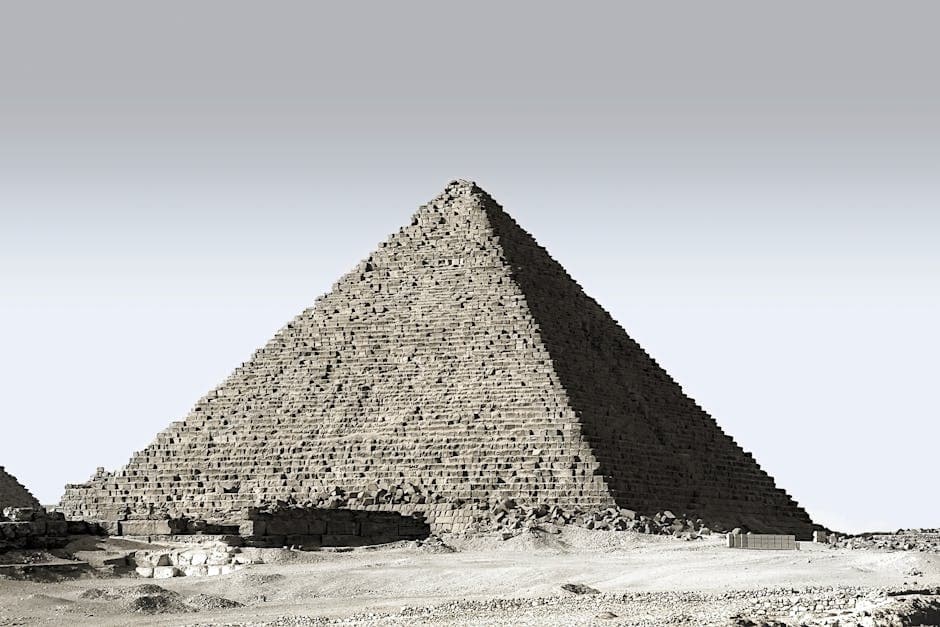
The Pyramids of Giza: How Were They Really Built?
Over 2 million stone blocks, precision engineering, and zero blueprints. The Great Pyramid of Giza remains one of history's greatest unsolved construction puzzles.
In the year 2560 BCE, give or take a few decades, workers placed the final casing stone on a structure that would remain the tallest building on Earth for the next 3,800 years. The Great Pyramid of Khufu stands 146 meters tall, contains an estimated 2.3 million stone blocks averaging 2.5 tons each, and covers 13 acres at its base. Its sides are aligned to true north with an accuracy of less than one-fifteenth of a degree. And somehow, a Bronze Age civilization with no iron tools, no wheels (as far as we know), and no written construction plans pulled it off in roughly 20 years.
We know more about the pyramids than ever before. But the deeper researchers dig, the more questions surface.
What You'll Learn
- •Who Built the Pyramids (And It Wasn't Slaves)?
- •The Three Pyramids of Giza: A Quick Guide
- •How Did They Cut and Move 2.3 Million Blocks?
- •The Lost River That Changed Everything
- •Ramp Theories: The Great Debate
- •The Diary of Merer: A 4,500-Year-Old Construction Log
- •Hidden Chambers: What's Inside the Great Pyramid?
- •Why Were the Pyramids Built?
- •What We Still Don't Know
- •Frequently Asked Questions
Who Built the Pyramids (And It Wasn't Slaves)?
Let's put one myth to rest immediately. The pyramids weren't built by slaves. This misconception traces back to the Greek historian Herodotus, who visited Egypt around 450 BCE, more than 2,000 years after the pyramids were completed, and reported that 100,000 enslaved people did the work.
Modern archaeology tells a very different story. In 1990, a tourist's horse stumbled into a previously unknown cemetery near the pyramids. Excavations led by Egyptian archaeologist Zahi Hawass and American Egyptologist Mark Lehner uncovered the tombs of pyramid workers, along with an entire workers' village. The evidence was clear: these were skilled laborers who ate well (beef, fish, and beer), received medical care (healed bones show evidence of on-site treatment), and were buried with honor near the monument they helped create. No enslaved person would have received that treatment.
Current estimates suggest a permanent workforce of about 4,000 skilled workers supplemented by rotating crews of roughly 20,000 seasonal laborers, likely farmers working during the Nile's annual flood when their fields were underwater. This was a national project, not a punishment detail.

The Three Pyramids of Giza: A Quick Guide
The Giza plateau holds three major pyramids, each built for a different pharaoh of the Fourth Dynasty (roughly 2600 to 2500 BCE).
The Great Pyramid of Khufu (Cheops): The largest and oldest. Originally 146.6 meters tall (now 138.5 meters after losing its outer casing stones and capstone). Built around 2560 BCE. Contains the King's Chamber, Queen's Chamber, Grand Gallery, and recently discovered hidden corridors. Its base is level to within just 2.1 centimeters across its entire 230-meter span.
The Pyramid of Khafre (Chephren): Built by Khufu's son. Slightly smaller at 136 meters, though it appears taller because it sits on higher ground. It still retains some of its original white limestone casing at the apex, giving us a glimpse of how all three pyramids once looked: smooth, gleaming white, visible for miles. The Great Sphinx sits beside its valley temple.
The Pyramid of Menkaure (Mycerinus): The smallest at 65 meters, built by Khafre's successor. Despite its smaller size, its lower courses were cased in granite rather than limestone, an extraordinarily labor-intensive choice. In 2025, researchers from Cairo University and the Technical University of Munich discovered two previously unknown air-filled cavities inside this pyramid using radar, electrical resistivity, and ultrasound techniques.
How Did They Cut and Move 2.3 Million Blocks?
The core blocks of the Great Pyramid are limestone, quarried from deposits just 300 meters south of the building site. Workers used copper tools, wooden wedges (which expand when soaked with water to split rock along natural fault lines), and dolerite pounders to shape them. This part isn't really mysterious; similar quarrying techniques have been documented across the ancient world.
The real questions involve the precision stones. The casing blocks, made of fine white Tura limestone from quarries across the Nile, were cut so precisely that you can't fit a razor blade between them. The King's Chamber is lined with granite blocks weighing up to 80 tons each, transported from Aswan, over 800 kilometers to the south. These were shaped with such accuracy that they fit together without mortar.
How did they achieve tolerances that would challenge modern masons? Part of the answer may lie in their use of copper saws combined with abrasive sand, a slow but highly precise cutting method. Experimental archaeology has shown it works, though it requires enormous patience and material. The ancient Egyptians had both.

The Lost River That Changed Everything
For years, one of the biggest puzzles was logistics. The Giza pyramids sit at the edge of the desert, kilometers from the modern Nile. How did workers transport millions of tons of stone to such a remote location?
In May 2024, a groundbreaking study published in Communications Earth & Environment by Eman Ghoneim of the University of North Carolina Wilmington provided the answer. Using radar satellite imagery, geophysical surveys, and deep soil coring, her team identified a long-buried branch of the Nile that once flowed right past the Giza plateau. They named it the Ahramat Branch (from the Arabic word for "pyramids").
The Ahramat Branch was roughly 64 kilometers long and ran along the Western Desert, passing within walking distance of at least 31 pyramids built between approximately 2686 and 1650 BCE. Many of these pyramids have causeways, stone-paved processional roads, that lead directly toward the ancient riverbanks, strongly suggesting the river was used as a highway for transporting construction materials.
The branch gradually silted up and migrated eastward, likely due to a combination of drought and sand accumulation during the late Old Kingdom. By around 2000 BCE, it was largely gone, which may partly explain why large-scale pyramid construction declined.
This discovery doesn't just explain how stone got to Giza. It explains why the pyramids were built where they are in the first place.
Ramp Theories: The Great Debate
Everyone agrees that ramps were involved in building the pyramids. The question is: what kind?
Straight ramp theory: The simplest idea. A single ramp rises from ground level to the working height, extended as the pyramid grows. The problem: by the time you reach the top, a ramp at a usable 7-degree slope would need to be over a kilometer long and contain more material than the pyramid itself. No evidence of such a ramp has been found.
Wrap-around ramp theory: A ramp spiraling up the outside of the pyramid. This requires less material but creates structural challenges: the corners become difficult to navigate with heavy loads, and surveying crews can't check the pyramid's geometry because the ramp covers the faces. Still, many Egyptologists consider this the most practical option.
Internal ramp theory: Proposed by French architect Jean-Pierre Houdin in 2007, this theory suggests an internal spiral ramp was built into the pyramid structure itself. Houdin points to a microgravimetry survey that detected a spiral-shaped anomaly of lower density within the Great Pyramid, which could represent an internal passage. This theory is elegant but remains open.
Hydraulic lift theory: A 2024 study published in PLOS ONE proposed that the Step Pyramid of Djoser at Saqqara (an earlier pyramid) may have used water-powered hydraulic lifts to raise stones. The idea involves flooding internal shafts to float stone blocks upward. However, Cambridge geoarchaeologist Judith Bunbury noted there's no documentation or ancient depictions of such devices, and most Egyptologists remain skeptical of applying this theory to Giza.
The truth is probably a combination. Most Egyptologists believe the builders used external ramps for the lower courses (which contain the vast majority of the total stone volume), then switched to some other method, possibly levers, internal ramps, or techniques we haven't imagined, for the upper portions.

The Diary of Merer: A 4,500-Year-Old Construction Log
In 2013, French archaeologist Pierre Tallet made one of the most remarkable discoveries in Egyptology. While excavating man-made caves at the ancient harbor of Wadi al-Jarf on the Red Sea coast, his team found rolls of papyrus that turned out to be the oldest known papyrus documents in the world.
Among them was the diary of an inspector named Merer, who led a crew of about 40 workers during the final years of building the Great Pyramid. His logbook, written in hieratic script, describes a three-month period of shipping limestone blocks from the Tura quarries across the Nile to Giza. The entries are remarkably conventional for such a monumental project: load stones, sail to Giza, unload, return, repeat. Each round trip took about four days.
The diary mentions the Great Pyramid by its original name: Akhet-Khufu, meaning "Horizon of Khufu." It also names Ankhhaf, Pharaoh Khufu's half-brother, as the overseer at the Giza harbor, confirming details known from other archaeological sources.
What makes Merer's diary so significant isn't just its age. It's that it transforms pyramid construction from myth into documented logistics. These weren't mysterious forces at work. It was organized labor, careful scheduling, and river transport, managed with the same bureaucratic record-keeping you'd find in any large construction project today.
Hidden Chambers: What's Inside the Great Pyramid?
The known interior of the Great Pyramid includes the King's Chamber (with an empty granite sarcophagus), the Queen's Chamber (which likely never held a queen), the Grand Gallery (a corbelled corridor rising at a 26-degree angle), and various shafts and passages. But recent technology has revealed there's more.
In 2017, the ScanPyramids project, an international collaboration using muon radiography (a technique that detects cosmic ray particles passing through solid structures), announced the discovery of a massive void above the Grand Gallery. This "Big Void" is at least 30 meters long and represents the first major structural discovery inside the Great Pyramid since the 19th century.
Then in 2023, the same team published detailed results in Nature Communications confirming a previously suspected corridor near the pyramid's north face. The North Face Corridor is roughly 9 meters long, 2 meters wide, and 2 meters tall. It sits behind the original entrance's chevron-shaped stones. Its purpose remains unknown, but it may lead to or protect something deeper within the structure.
In 2025, researchers turned their attention to the Pyramid of Menkaure, where radar and ultrasound surveys detected two air-filled anomalies that could indicate unknown chambers or passages. Investigations are ongoing.
Nobody knows what, if anything, these voids contain. The Great Pyramid may have been thoroughly looted millennia ago, or it may still hold undiscovered chambers. The technology exists to look without drilling; we just need time and access.

Why Were the Pyramids Built?
The straightforward answer: they were tombs for pharaohs. Khufu, Khafre, and Menkaure all intended to be buried within their respective pyramids as part of the ancient Egyptian belief system. The pharaoh was considered a living god whose body needed to be preserved and housed in a structure grand enough to ensure his successful passage to the afterlife.
But "tombs" undersells it. The pyramids were:
Resurrection machines. Ancient Egyptian texts describe the pyramid as a device for launching the pharaoh's spirit (ka) into the afterlife. The very shape, pointing toward the sky, may have symbolized the primordial mound from which creation emerged, or the rays of the sun descending to earth.
Statements of power. Building a pyramid required controlling a massive labor force, a sophisticated supply chain, and a centralized economy. The pyramid itself was proof that the pharaoh could organize civilization on a scale nobody else could match.
Economic engines. The workers' villages, supply chains, and administrative systems created to build the pyramids may have helped unify Egypt as a nation-state. Some scholars argue that the process of building was almost as important as the finished product.
Centers of ongoing ritual. Each pyramid had an associated mortuary temple (on the east side) and valley temple (near the river), connected by a causeway. Priests maintained these temples for generations after the pharaoh's death, performing daily rituals and making offerings.
What We Still Don't Know
Despite everything we've learned, fundamental questions remain open.
The precision problem. The Great Pyramid's base is level to within 2.1 centimeters across 230 meters. Its sides differ in length by less than 4.4 centimeters. How did builders achieve this without modern surveying equipment? Water leveling and stellar alignment have been proposed, but replicating this accuracy experimentally has proven difficult.
The upper construction method. We have plausible theories for how the lower 60% of the pyramid was built (ramps), but the top 40%, especially the King's Chamber with its 80-ton granite beams raised to a height of about 65 meters, remains genuinely puzzling.
The organization. How do you coordinate 20,000+ workers across a 20-year project without written plans, standardized measurements, or (as far as we know) architectural drawings? The logistics alone are staggering.
What's in the voids? The Big Void and the North Face Corridor detected by muon scans haven't been physically explored. They may be empty structural features, or they may contain artifacts, texts, or burial goods that could rewrite Egyptian history.
The pyramids remind us that ancient doesn't mean simple. These were built by people who understood mathematics, astronomy, geology, and project management at levels that still impress engineers today. The mystery isn't whether humans could have built them. We know they did. The mystery is the precise details of how, and what else they might have left behind inside.
For more ancient construction mysteries, explore Stonehenge, where builders moved 25-ton stones across Britain without wheels. Or investigate the Nazca Lines, massive desert drawings visible only from the sky. And if you're curious about mysterious objects, the Voynich Manuscript is a 600-year-old book nobody can read.
Frequently Asked Questions
How long did it take to build the Great Pyramid?
Most Egyptologists estimate about 20 years, based on the reign length of Pharaoh Khufu (roughly 2589 to 2566 BCE). This means workers had to place an average of roughly 340 blocks per day, or one block every few minutes during working hours. Recent calculations suggest the bulk of the work was done in closer to 10 to 14 years, with the remainder spent on finishing and casing.
Were the pyramids aligned with the stars?
The Great Pyramid is aligned to true north with remarkable precision (within 3/60th of a degree). Egyptologist Kate Spence proposed in 2000 that builders achieved this by sighting on two circumpolar stars, Kochab and Mizar, as they rotated around the celestial pole. The sides also align closely with the cardinal directions. Whether the internal shafts point to specific stars (like Orion's Belt) remains debated.
How many workers built the pyramids?
Archaeological evidence from the workers' village suggests a core team of about 4,000 year-round skilled workers (stone cutters, surveyors, and supervisors) supplemented by roughly 16,000 to 20,000 seasonal laborers who rotated in during the Nile flood season. These workers were organized into crews with names like "Friends of Khufu" and "Drunkards of Menkaure."
Could we build the Great Pyramid today?
Structurally, yes. The engineering is well understood, and modern machinery could handle the stone moving. But it would be extraordinarily expensive. Various estimates range from $1 billion to $5 billion, and it would still take years even with modern cranes and trucks. The original builders' achievement is even more remarkable given their limited tools.
Why is there no mummy inside the Great Pyramid?
The King's Chamber contains an empty, lidless granite sarcophagus, but no mummy has ever been found inside any of the Giza pyramids. The by one account explanation is tomb robbery, which was rampant in ancient Egypt. Records from later dynasties describe efforts to stop grave robbers, suggesting the pyramids were looted centuries or millennia before modern archaeologists arrived.
Want to explore more mysteries?
We've got plenty more rabbit holes to go down.