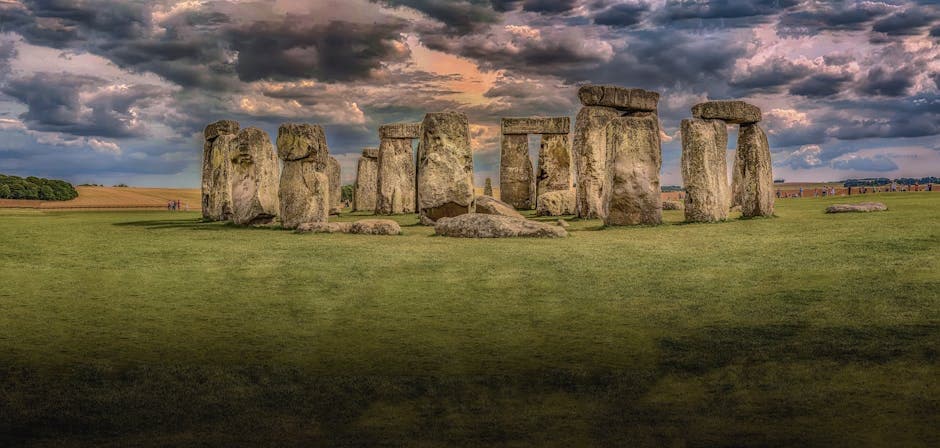
Stonehenge: Why Was It Built and How Did They Do It?
Built over 1,000 years on Salisbury Plain, Stonehenge's purpose and construction still baffle researchers. From solar calendars to healing shrines, here's what we know.
The stones have been standing on Salisbury Plain for nearly 5,000 years. Generations of farmers, druids, scholars, and tourists have walked among them, looked up, and asked the same question: why? Stonehenge isn't just old. It's deliberately, painstakingly, almost impossibly engineered, built in stages over more than a thousand years by people who left no written explanation. And in 2024, researchers discovered that its central Altar Stone traveled over 750 kilometers from northeastern Scotland, a finding that rewrites everything we thought we knew about Neolithic Britain's connectedness.
We still don't know exactly what Stonehenge was for. But we've never been closer to piecing it together.
What You'll Learn
- •A Timeline of Construction: 3000 BCE to 1500 BCE
- •Where Did the Stones Come From?
- •How Did They Move 25-Ton Stones Without Wheels?
- •Was Stonehenge a Solar Calendar?
- •Was It a Healing Shrine?
- •The Unification Theory: A Monument to Bring People Together
- •Was Stonehenge a Cemetery?
- •The Altar Stone Revelation of 2024
- •What Stonehenge Tells Us About Neolithic Society
- •Frequently Asked Questions
A Timeline of Construction: 3000 BCE to 1500 BCE
Stonehenge wasn't built all at once. It evolved over roughly 1,500 years, which is longer than the time between the fall of Rome and today.
Phase 1 (around 3000 BCE): The earliest Stonehenge was a circular ditch and bank, about 110 meters across, with a ring of 56 pits known as the Aubrey Holes (named after 17th-century antiquarian John Aubrey). Cremated human remains have been found in many of these holes, suggesting the site began as a cremation cemetery.
Phase 2 (around 2900 to 2500 BCE): Timber posts were erected within the enclosure. The site continued to function as a place of burial, with more cremated remains deposited over several centuries. Radiocarbon dating of these remains, conducted by researchers at University College London, indicates that Stonehenge served as a cemetery for at least 500 years.
Phase 3 (around 2500 BCE): This is when Stonehenge became the monument we recognize. Enormous sarsen stones, some weighing over 25 tons, were brought from the Marlborough Downs about 25 kilometers to the north. Smaller bluestones, each weighing up to four tons, arrived from the Preseli Hills in Wales, roughly 200 kilometers away. They were arranged into the iconic horseshoe and circle formations, complete with lintels held in place by mortise-and-tenon joints, a technique more commonly associated with woodworking.
Phase 4 (around 2280 to 1500 BCE): The bluestones were rearranged multiple times. The Avenue, a processional route connecting Stonehenge to the River Avon, was constructed. Activity at the site gradually declined after 1600 BCE.

Where Did the Stones Come From?
Two types of stone make up Stonehenge, and each tells a different story.
Sarsen stones form the outer circle and the massive trilithons (two uprights capped by a lintel). In 2020, a study published in Science Advances by Professor David Nash at the University of Brighton used portable X-ray fluorescence to determine that 50 of the 52 remaining sarsens share the same chemical composition. They traced them to West Woods, near Marlborough, about 25 kilometers north of Stonehenge.
Bluestones are the smaller inner stones, and for decades researchers have known they came from the Preseli Hills in Pembrokeshire, Wales. In 2021, a team led by Mike Parker Pearson at UCL proposed that a dismantled stone circle at Waun Mawn in Wales was the original source. The Waun Mawn circle had the same diameter as the Stonehenge bluestone arrangement and shared stone types.
Then came the bombshell.
The Altar Stone, the large recumbent slab at the heart of the monument, had always been assumed to come from Wales too. But a 2024 study published in Nature by researchers at Curtin University and Aberystwyth University used mineral dating and chemical analysis to prove it actually came from the Orcadian Basin in northeastern Scotland, more than 750 kilometers away. This was, as one researcher put it, "jaw-dropping."

How Did They Move 25-Ton Stones Without Wheels?
This is one of the most debated questions in archaeology, and there's no single answer because different stones probably traveled different ways.
For the sarsens (25 km journey): Most researchers believe they were dragged on wooden sledges, possibly over greased rails or log rollers. Experimental archaeology has shown that a team of about 200 people could move a sarsen-sized stone this way. The route from West Woods to Stonehenge is mostly downhill or level, which helps.
For the bluestones (200 km from Wales): This is trickier. Some archaeologists, including Parker Pearson, believe they were transported by human labor, possibly a combination of sledges overland and rafts along the coast and up rivers. Others, including geologist Brian John, have argued that glaciers deposited bluestones on Salisbury Plain during the Ice Age, though this remains a minority view since no glacial deposits of bluestone have been found in the area.
For the Altar Stone (750+ km from Scotland): The 2024 discovery has sparked fresh debate. A six-ton stone traveling that distance by some interpretations required sea transport. Researchers believe it was likely moved by boat along Scotland's coast, down through the Irish Sea or North Sea, and then up rivers to Salisbury Plain. This implies Neolithic Britons had sophisticated maritime capabilities far beyond what we previously assumed.
The construction techniques at the site itself are equally impressive. The builders used mortise-and-tenon joints to lock lintels onto uprights and tongue-and-groove joints to connect lintels to each other. They also "entasis-corrected" the stones, tapering them slightly to create the optical illusion of straight lines when viewed from below. These are techniques the ancient Greeks wouldn't use for another 2,000 years.
Was Stonehenge a Solar Calendar?
In 2022, Professor Timothy Darvill of Bournemouth University published a study in the journal Antiquity arguing that Stonehenge functioned as a perpetual solar calendar based on a 365.25-day year.
His reasoning centers on the numerology of the sarsen stones. The outer circle originally contained 30 uprights. Each stone could represent 12 days, giving 360 days. Add the five trilithon structures in the horseshoe for five extra days, and you get 365. The four Station Stones at the perimeter could mark the leap year correction of one extra day every four years.
The monument's alignment supports this: on the summer solstice, the sun rises directly over the Heel Stone and shines into the heart of the monument. On the winter solstice, the sun sets along the same axis in the opposite direction.
Not everyone agrees. Archaeologists Giulio Magli and Juan Antonio Belmonte published a rebuttal arguing that the stone count interpretation is too speculative and that other Neolithic monuments with similar stone counts don't appear to function as calendars. The debate continues.

Was It a Healing Shrine?
Professor Darvill and colleague Geoffrey Wainwright proposed in 2008 that Stonehenge was essentially a prehistoric Lourdes, a place people traveled to for healing. Their evidence focuses on the bluestones.
The Preseli Hills in Wales, where the bluestones originated, have natural springs with reputed healing properties. Several human remains found at Stonehenge show signs of illness or injury, and isotope analysis reveals that some of these people traveled great distances to reach the site. One skeleton, known as the "Amesbury Archer," came from the Alps. Another individual came from the Mediterranean region.
The counterargument is that these travelers could have visited Stonehenge for any number of reasons, not necessarily healing. And the presence of sick or injured people at a site doesn't automatically make it a hospital. Still, the deliberate transport of bluestones from a region associated with healing springs is hard to dismiss entirely.
The Unification Theory: A Monument to Bring People Together
A December 2024 study by archaeologists at University College London and Aberystwyth University proposed what might be the most compelling theory yet: Stonehenge was built as a symbol of political and cultural unification.
The evidence is the stones themselves. The sarsens came from Wiltshire (local). The bluestones came from Wales (western Britain). The Altar Stone came from Scotland (northern Britain). The builders deliberately sourced materials from across the island, even when local alternatives were available. Why transport a six-ton stone 750 kilometers when perfectly good rocks sit nearby?
The researchers argue this wasn't just practical, it was symbolic. By incorporating stones from different regions, the monument physically represented the bringing together of distinct communities. This interpretation aligns with evidence from the nearby settlement at Durrington Walls, where pig bones and pottery indicate that people from across Britain gathered for seasonal feasts.
This theory doesn't necessarily contradict the others. Stonehenge could have been a calendar, a ceremonial gathering place, and a unifying symbol simultaneously, just as a cathedral serves as a church, a calendar (marking feast days), and a symbol of community identity all at once.
Was Stonehenge a Cemetery?
The evidence here is solid. Archaeologists have found the cremated remains of an estimated 150 to 240 individuals buried at Stonehenge, primarily in the Aubrey Holes and the surrounding ditch. These burials span about 500 years, from roughly 3000 to 2500 BCE.
Isotope analysis published by Christophe Snoeck and colleagues in Scientific Reports (2018) revealed that about 40% of the cremated individuals weren't local to the Stonehenge area. Some came from western Britain, possibly Wales, the same region where the bluestones originated. This suggests a connection between the people buried at Stonehenge and the communities that supplied its stones.
Parker Pearson has proposed that Stonehenge was a domain of the dead, contrasting with the nearby timber circle at Durrington Walls, which was a domain of the living. The two sites are connected by the River Avon and their respective avenues, forming what he calls a landscape of life and death.

The Altar Stone Revelation of 2024
The August 2024 Nature study deserves its own section because of how dramatically it changes our understanding of Neolithic Britain.
For decades, the Altar Stone, a roughly six-ton slab of greenish sandstone lying at the focal point of the monument, was assumed to come from Wales alongside the other bluestones. Geologists had tried repeatedly to match it to Welsh rock formations but kept "drawing a blank," as co-author Professor Richard Bevins explained.
The breakthrough came when researchers at Curtin University in Australia used uranium-lead dating of zircon crystals within the stone. The mineral signatures didn't match anything in Wales. Instead, they pointed clearly to the Old Red Sandstone formations of the Orcadian Basin in northeastern Scotland.
This finding has staggering implications. It means that around 2500 BCE, people in what's now Scotland either transported or arranged the transport of a massive stone over 750 kilometers to Wiltshire. The by one account route involved sea travel, suggesting Neolithic Britons had boat-building capabilities and navigational knowledge far more advanced than previously believed.
It also implies a level of social organization and inter-regional cooperation that challenges the old image of isolated Neolithic farming communities. These weren't scattered villages. They were part of a connected, coordinated civilization capable of monumental projects spanning the entire island of Britain.
What Stonehenge Tells Us About Neolithic Society
Perhaps the biggest mystery of Stonehenge isn't any single question about its purpose or construction. It's what the monument reveals about the people who built it.
They could move multi-ton stones hundreds of kilometers by land and sea. They understood astronomical alignments precise enough to track solstices. They used construction techniques (mortise-and-tenon joints, entasis correction) that wouldn't appear elsewhere in Europe for millennia. They organized labor forces numbering in the hundreds or thousands over generations. And they maintained a vision for a single project across more than a thousand years.
These weren't primitive people stumbling through prehistory. They were engineers, astronomers, organizers, and visionaries. We just can't read their intentions because they left no written records.
That's what makes Stonehenge so enduring as a mystery. The evidence tells us what they did. It hints at how they did it. But the why remains gloriously, frustratingly open.
For more ancient mysteries that challenge our understanding of prehistoric civilizations, explore the Nazca Lines of Peru, giant drawings that can only be seen from the sky. Or investigate the Voynich Manuscript, a 600-year-old book that nobody can read. And if unexplained disappearances intrigue you, the story of the lost colony of Roanoke offers another puzzle with no clean answers.
Frequently Asked Questions
Who built Stonehenge?
Stonehenge was built by Neolithic and Bronze Age peoples of Britain over a period of roughly 1,500 years (3000 to 1500 BCE). They weren't a single group but successive generations of farming communities. Despite popular myths, the druids documented by the Romans arrived thousands of years after construction began.
How old is Stonehenge?
The earliest phase of Stonehenge dates to around 3000 BCE, making the site roughly 5,000 years old. The iconic stone circle we recognize today was erected around 2500 BCE. Construction and modification continued until approximately 1500 BCE.
Why is the summer solstice important at Stonehenge?
On the summer solstice (around June 21), the sun rises directly over the Heel Stone and its light streams into the center of the monument. On the winter solstice, the sun sets along the same alignment in the opposite direction. This deliberate solar alignment suggests the builders placed great importance on marking the turning points of the year.
Could Stonehenge have been built by aliens?
There's no widely accepted evidence for extraterrestrial involvement. Every construction technique used at Stonehenge, from sledge transport to mortise-and-tenon joinery, has parallels in other ancient human cultures. The "ancient aliens" narrative underestimates the ingenuity of Neolithic people, who achieved remarkable engineering feats across the globe using tools and techniques well within human capability.
How were the Stonehenge bluestones transported from Wales?
The most widely accepted theory is that the bluestones were transported by human labor using a combination of wooden sledges, rollers, and rafts. The roughly 200-kilometer journey from the Preseli Hills likely followed coastal and river routes. A minority of researchers have suggested glacial transport, but the geological evidence doesn't support bluestone glacial deposits on Salisbury Plain.
Want to explore more mysteries?
We've got plenty more rabbit holes to go down.