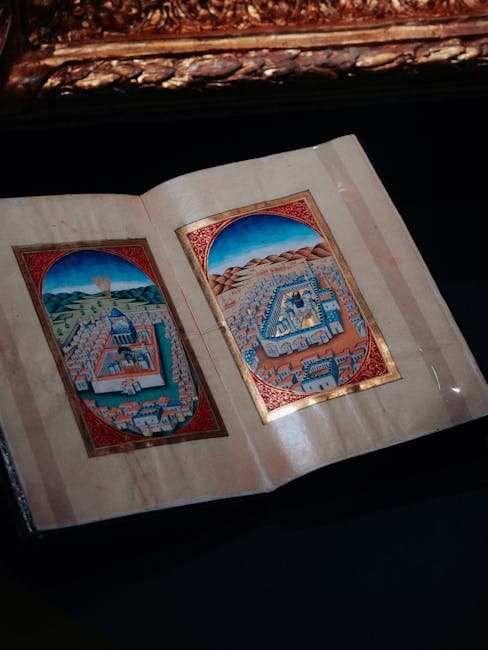
The Voynich Manuscript: The Book Nobody Can Read
A 600-year-old manuscript written in an unknown script with bizarre illustrations has defeated every codebreaker who's tried. Here's what we know about the Voynich manuscript.
It's been sitting in Yale University's rare book library since 1969. Two hundred and forty pages of handwritten text in a script nobody recognizes, illustrated with plants that don't exist, astronomical diagrams that don't match any known system, and drawings of naked women bathing in green liquid connected by elaborate plumbing. The Voynich manuscript has stumped every codebreaker, linguist, and amateur sleuth who's taken a crack at it for over a century.
This isn't some fringe curiosity. World War II codebreakers who cracked enemy ciphers couldn't make sense of it. The NSA took a look. Artificial intelligence has been thrown at it. Nobody's gotten anywhere. Carbon dating puts the parchment between 1404 and 1438, making it roughly 600 years old. But who wrote it, what language it's in, and what it actually says remain completely unknown.
Here's everything we know about the world's most mysterious book.
What You'll Learn
- •What Is the Voynich Manuscript?
- •How Was the Manuscript Discovered?
- •What's Actually Inside the Manuscript?
- •Is the Voynich Script a Real Language?
- •Who Tried to Decode It?
- •Could It Be a Medieval Hoax?
- •Was It Written in a Lost or Constructed Language?
- •What Do Modern AI Attempts Show?
- •Who Actually Wrote the Voynich Manuscript?
- •Why Does It Still Matter?
- •Frequently Asked Questions
What Is the Voynich Manuscript?
The Voynich manuscript is a hand-written codex, cataloged as Beinecke MS 408 at Yale University's Beinecke Rare Book and Manuscript Library. It contains roughly 240 pages of text written entirely in an unknown script that researchers call "Voynichese." The vellum (calfskin parchment) has been radiocarbon dated to between 1404 and 1438, placing its creation firmly in the early 15th century.
The manuscript measures about 23.5 by 16.2 centimeters, roughly the size of a modern paperback. It's written from left to right using what appears to be a consistent alphabet of 20 to 25 characters. The text flows naturally, with paragraph breaks and what look like section headings. It doesn't look like random gibberish scrawled by a madman. It looks like someone sat down with a purpose and wrote a book.
What makes it truly strange are the illustrations. The manuscript contains hundreds of drawings of unidentifiable plants, astronomical charts, what appear to be pharmaceutical recipes, and groups of small naked women bathing in pools of green and blue liquid connected by pipe-like structures. None of the plants match any known species. The astronomical diagrams don't correspond to any recognized system.
The parchment was made from at least fourteen or fifteen entire calfskins. It's not a luxury item; there's no gold leaf, no elaborate decoration. The vellum shows wear from heavy use, suggesting someone actually used this book regularly. Whoever made it invested significant resources but wasn't trying to create a showpiece.

How Was the Manuscript Discovered?
The earliest confirmed owner was Georg Baresch, a 17th-century alchemist living in Prague. Baresch was apparently frustrated by the book's contents, writing in 1637 to Athanasius Kircher, a Jesuit scholar in Rome famous for his work on ancient languages. Baresch described the manuscript as a mysterious volume that had been "taking up space uselessly in his library" and asked Kircher to help decode it. There's no record that Kircher ever succeeded.
When Baresch died, the manuscript passed to Jan Marek Marci, rector of Charles University in Prague. In 1665 or 1666, Marci sent it to Kircher along with a letter claiming that the book had once belonged to Holy Roman Emperor Rudolf II, who allegedly paid 600 gold ducats for it (roughly $90,000 in today's money). Marci's letter also mentioned that Roger Bacon, the 13th-century English friar and early scientist, might have been the author. This Bacon attribution would haunt the manuscript's history for centuries.
The manuscript then disappeared from the historical record for roughly 250 years. It apparently sat in the library of the Collegio Romano, the Jesuit university in Rome, until 1912. That's when Wilfrid Voynich, a Polish-born antiquarian book dealer based in London, purchased it along with other manuscripts from the Jesuits, who were selling off their collection due to financial difficulties.
Voynich immediately recognized the manuscript as extraordinary. He spent years trying to decode it and promoting it to scholars, but he never cracked it. After his death in 1930, the manuscript passed through his wife Ethel, then to her friend Anne Nill, and eventually to book dealer Hans Peter Kraus. Unable to find a buyer, Kraus donated it to Yale in 1969.
What's Actually Inside the Manuscript?
Scholars have divided the manuscript into six sections based on the illustrations, though there's debate about exactly where one section ends and another begins.
The Herbal Section takes up the largest portion, roughly 130 pages. Each page typically shows a single plant with accompanying text. The problem? Almost none of these plants can be identified as real species. Some researchers have suggested they're stylized versions of known plants, while others think they might be entirely imaginary. A few bear vague resemblances to plants found in medieval herbals, but nothing definitive.
The Astronomical Section contains circular diagrams that look like they could be astronomical charts or astrological diagrams. Some pages show what appear to be zodiac symbols, and there are circular patterns with stars. One famous foldout page shows what might be a star map or cosmological diagram. But the details don't match any known astronomical tradition from the period.
The Balneological Section is perhaps the strangest. It shows dozens of small female figures, many of them nude, bathing in pools or tubs connected by an elaborate system of pipes and channels filled with green or blue liquid. Nobody has convincingly explained what this section represents. Suggestions range from illustrations of medieval bathing practices to diagrams of the body's circulatory system to something entirely outside our frame of reference.
The Cosmological Section features circular diagrams with elaborate designs, including what appear to be islands or landmasses connected by causeways. Some researchers see maps, others see cellular structures, and others see purely symbolic or decorative elements.
The Pharmaceutical Section shows rows of labeled jars or containers alongside plant parts, resembling pages from a medieval apothecary's manual. The containers look like those used to store medicines or herbal preparations.
The Recipes Section at the end consists of dense text with star-like markers in the left margins, with minimal illustrations. These pages look like they could contain instructions or formulas of some kind.
Is the Voynich Script a Real Language?
This is the central question, and the evidence points in multiple directions.
Statistical analysis shows that Voynichese behaves like a natural language in some ways but not others. The text follows Zipf's law, a statistical pattern found in virtually all human languages where word frequency follows a specific mathematical distribution. It has consistent word lengths and patterns of word repetition that look linguistic rather than random.
However, Voynichese also has some deeply unusual properties. Its "entropy," a measure of information density, is lower than any known natural language. Characters in Voynichese are far more predictable than in real languages. There are almost no words shorter than two characters or longer than ten. Certain characters almost never appear at the beginning of words, while others almost never appear at the end.
Claire Bowern, a linguist at Yale who's studied the manuscript extensively, has noted that at higher levels of organization, the text displays properties consistent with natural language. She's dismissed the idea that it's pure gibberish. But the low entropy remains a puzzle.
Prescott Currier, a US Navy cryptographer who studied the manuscript in the 1970s, identified what he called two distinct "languages" or "hands" in the text, which he labeled Language A and Language B. Different sections of the manuscript tend to use one or the other. This could mean two different scribes, two different dialects, or two different encryption methods.
More recent analysis by medievalist Lisa Fagin Davis suggests as many as five different scribes worked on the manuscript, based on handwriting analysis. If multiple people created the text, it's less likely to be a lone hoaxer's invention and more likely the product of a community using a shared system.
Who Tried to Decode It?
The list of people who've failed to crack the Voynich reads like a who's who of cryptography.
William Newbold (1921) was a professor at the University of Pennsylvania who claimed to have deciphered the manuscript using a complex system of microscopic shorthand he saw in the characters. His "translation" suggested Roger Bacon had used the manuscript to describe microscopes and telescopes centuries before their invention. Other scholars quickly dismantled his method, showing that the microscopic markings were just cracks in the aging ink.
William and Elizebeth Friedman spent decades on the manuscript. William Friedman was the man who broke the Japanese PURPLE cipher in World War II, arguably the greatest codebreaker in American history. He and his wife formed study groups in the 1940s and 1950s. They concluded the text was probably written in a constructed language, not a cipher of an existing one. But they couldn't read it.
John Tiltman, a top British codebreaker who worked at Bletchley Park, studied the manuscript in the 1950s. He identified patterns in how words were constructed but couldn't decode the text. He noted that the script seemed to have a limited set of components that combined in systematic ways, almost like a modular writing system.
The NSA declassified documents in the 2000s revealing that American military cryptographers had studied the manuscript during the Cold War. They didn't crack it either.
In 2014, Stephen Bax, a linguist at the University of Bedfordshire, claimed to have identified about 14 characters by comparing plant illustrations with known medieval herbals. He matched some Voynichese words to plants whose names sounded similar in various historical languages. His work was intriguing but hasn't been independently verified, and Bax passed away in 2017 before completing his analysis.
Gerard Cheshire published a paper in 2019 claiming the manuscript was written in proto-Romance, a hypothetical precursor to modern Romance languages. His claims were widely rejected by medieval scholars and linguists, who pointed out numerous methodological problems. Lisa Fagin Davis called the paper "complete nonsense" on social media.
Could It Be a Medieval Hoax?
The hoax theory has some appeal. If the text is meaningless, that would explain why nobody can decode it. And there's a clear candidate for the hoaxer: Wilfrid Voynich himself.
Voynich was a book dealer who would have profited enormously from "discovering" a sensational manuscript. He had access to old parchment and the knowledge to create a convincing forgery. Some skeptics, including book historian Gordon Rugg, have argued the manuscript could have been produced using a technique called a Cardan grille, a card with holes cut in it that's placed over a table of syllables. Moving the grille across the table generates text that looks systematic but carries no meaning.
Rugg demonstrated in 2004 that this method could produce text with statistical properties similar to Voynichese. His work showed a hoax was at least possible.
But there are serious problems with the hoax theory. The radiocarbon dating puts the parchment firmly in the early 1400s, over 500 years before Voynich acquired it. While a forger could theoretically have written on old parchment, the inks have also been analyzed and appear consistent with medieval materials. The manuscript shows signs of heavy use over centuries, not something a modern forger could easily fake.
There's also the sheer scale of the effort. The manuscript contains roughly 38,000 words, about 170 pages of dense text plus elaborate illustrations. Creating a hoax this elaborate, on authentic 15th-century vellum, with period-appropriate inks and materials, just to sell a book? It's possible, but it's an extraordinary amount of work for an uncertain payoff.
If it's not Voynich's hoax, could it be a medieval hoax? Someone in the 15th century could have created a fake "magical book" to sell to a wealthy patron, like Emperor Rudolf II. Alchemists and occultists of the period were known for producing fraudulent texts. But again, the internal consistency of the script and the evidence of practical use argue against this.
Was It Written in a Lost or Constructed Language?
This is the theory that William Friedman favored, and it's gained traction among modern researchers.
A constructed language would explain many of the manuscript's odd properties. The low entropy, the unusual word structure, the systematic character patterns; these could all be features of an artificial writing system designed by someone without deep linguistic training. Medieval Europe had a tradition of creating artificial languages and scripts, often associated with mystical or philosophical purposes.
Some researchers have proposed the manuscript could be written in a natural language using an unfamiliar script. Candidates have included early Turkish, Vietnamese, an extinct Mesoamerican language, a variety of Hebrew or Arabic, and even an early form of Ukrainian. None of these proposals have held up under scrutiny.
A more recent theory, proposed by researchers analyzing the manuscript's statistical properties, suggests the text might encode a real language using a system that separates vowels from consonants. In some proposed decoding schemes, the vowels would be encoded separately from the consonants, producing text that appears to have low entropy because you're only seeing half the information on any given page.

The five-scribe hypothesis adds an interesting wrinkle. If a community produced the manuscript, the "language" might have been a shared code used by a specific group, perhaps a community of women herbalists, a religious sect, or a guild of medical practitioners who wanted to keep their knowledge private. Similar practices existed in the medieval period, like the Hildegard of Bingen's Lingua Ignota, a constructed language created by the 12th-century abbess.
What Do Modern AI Attempts Show?
With the rise of machine learning, several research teams have tried to decode the manuscript using artificial intelligence. The results have been fascinating but inconclusive.
In 2018, a team at the University of Alberta used AI to analyze the text and concluded it was by one account written in Hebrew, with the letters rearranged using alphagrams (alphabetically ordered anagrams). Their algorithm produced what they claimed was a partly readable text about agriculture and bathing. However, Hebrew scholars and medievalists quickly challenged the results, noting that the "decoded" text barely resembled coherent Hebrew.
Other AI analyses have focused on the statistical structure of the text rather than trying to decode it directly. These studies consistently find that Voynichese has properties of natural language but with unusual characteristics that don't match any known language family.
The fundamental problem with AI approaches is that machine learning needs training data, and there's nothing quite like Voynichese to train on. If the manuscript uses a unique encoding system or a language with no surviving relatives, there's no reference point for algorithms to work from.
Neural network analysis has been able to distinguish the two "languages" that Currier identified in the 1970s, confirming that there are indeed two distinct patterns in the text. This supports the multiple-scribe theory and suggests the differences aren't random variation but systematic distinctions.
Some researchers have also used AI to compare the manuscript's illustrations with known medieval sources. These analyses have found some parallels with Italian pharmaceutical manuscripts of the period, which might help narrow down the manuscript's origin, even if they can't decode the text.
Who Actually Wrote the Voynich Manuscript?
Several candidates have been proposed, though none have strong evidence.
Roger Bacon (1214-1294) was the original suspect, based on the letter that accompanied the manuscript when it was sent to Athanasius Kircher. Bacon was a Franciscan friar who wrote about optics, alchemy, and coded writing. But the radiocarbon dating places the parchment about 100 to 150 years after Bacon's death, effectively ruling him out unless someone copied an earlier Bacon original onto new parchment.
Wilfrid Voynich, as discussed, is the conspiracy theorist's favorite, but the physical evidence makes this unlikely.
Jakub of Tepenec (also known as Jacobus Sinapius), a pharmacist and alchemist who served Emperor Rudolf II, had his name faintly visible on the manuscript's first page (though this has been contested). He had the botanical knowledge and the connection to Rudolf's court that would fit.
Antonio Averlino Filarete, a 15th-century Italian architect and writer, has been proposed based on stylistic similarities between the manuscript's illustrations and Filarete's own architectural drawings. This theory, advanced by researcher Nick Pelling, places the manuscript's creation in 15th-century Italy, which matches the radiocarbon dating and stylistic analysis.
The truth is we simply don't know. The manuscript could have been created by any number of literate Europeans with access to calfskin parchment and iron gall ink in the early 15th century. The multiple-scribe evidence suggests it wasn't a single individual's project but a collaborative effort, which makes identifying a specific author even harder.
Why Does It Still Matter?
The Voynich manuscript occupies a unique place in the history of unsolved mysteries. Unlike many enigmas that rely on eyewitness testimony or ambiguous evidence, this one is a physical object you can examine. Yale has digitized the entire manuscript and made it freely available online. Anyone with an internet connection can study the same pages that stumped the NSA's best cryptographers.
It matters to linguists because if the text does encode a real language, decoding it could reveal a lost linguistic tradition. It matters to historians because a 600-year-old illustrated book with no known parallel could rewrite our understanding of medieval knowledge systems. And it matters to cryptographers because any encoding system that's resisted over a century of analysis, including computerized attacks, represents either a remarkably sophisticated cipher or something fundamentally different from what we expect.
The manuscript also serves as a humbling reminder that we haven't figured everything out. In an era when AI can translate languages in real time and genetic analysis can identify remains from centuries ago, the Voynich manuscript sits quietly in its library in New Haven, Connecticut, unreadable as ever.
Perhaps someone will crack it tomorrow. Perhaps it's a brilliantly executed hoax that was never meant to be read. Or perhaps it's a window into a way of thinking and encoding knowledge that we simply don't have the framework to understand yet.
If the Wow! Signal represents our best evidence of something unexplained from space, and the Nazca Lines show us ancient achievements we struggle to explain, the Voynich manuscript is the ultimate reminder that sometimes the deepest mysteries are the ones we can hold in our hands.
Frequently Asked Questions
Has the Voynich manuscript been decoded?
No. Despite over a century of effort by professional cryptographers, linguists, and AI researchers, nobody has produced a verified decoding of the manuscript. Several people have claimed to have cracked it, but none of their solutions have been accepted by the broader academic community.
Where can you see the Voynich manuscript?
The original manuscript is housed at Yale University's Beinecke Rare Book and Manuscript Library in New Haven, Connecticut. Yale has also digitized the entire manuscript, and you can view every page for free on the Beinecke Library's website.
How old is the Voynich manuscript?
Radiocarbon dating of the parchment places it between 1404 and 1438, making it roughly 600 years old. The text and illustrations are believed to be contemporaneous with the parchment based on ink analysis.
Is the Voynich manuscript a hoax?
It's possible but increasingly unlikely. The radiocarbon dating confirms the parchment is genuinely medieval, the inks are period-appropriate, and the text shows statistical properties consistent with natural language. The manuscript also shows signs of heavy practical use over centuries. While a hoax can't be completely ruled out, the evidence leans toward it being a genuine text in an unknown writing system.
What language is the Voynich manuscript written in?
Nobody knows. Proposals have included Hebrew, Latin, early Romance languages, Turkish, and various constructed languages. Statistical analysis shows the text has properties of natural language but doesn't match any known language family. The leading theories suggest it's either a natural language written in a unique script or a constructed language created for a specific purpose.
Want to explore more mysteries?
We've got plenty more rabbit holes to go down.