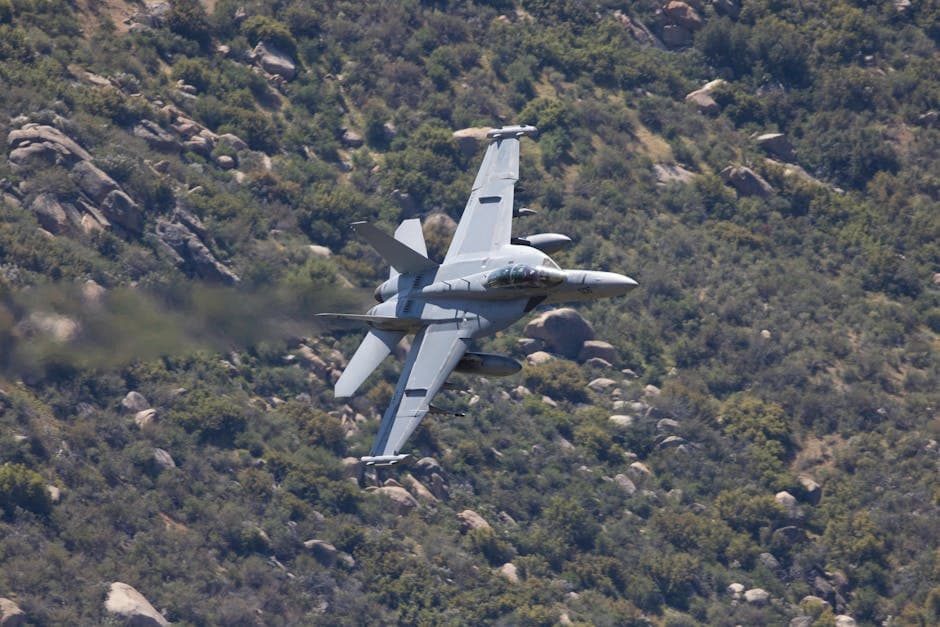
The Tic Tac UFO: When Navy Fighter Pilots Chased Something They Couldn't Explain
In November 2004, Navy pilots from the USS Nimitz encountered a white, oblong object off the coast of San Diego that outmaneuvered their F/A-18 Super Hornets. The Pentagon confirmed the encounter is real.
On November 14, 2004, about 100 miles southwest of San Diego, two F/A-18F Super Hornets from the aircraft carrier USS Nimitz were redirected from a training exercise to investigate something strange. For over a week, the carrier strike group's advanced radar system had been tracking mysterious objects that appeared at 80,000 feet, dropped to the ocean surface in seconds, and hovered before shooting back up. No known aircraft could do that.
What happened next, witnessed by four Navy aviators in broad daylight over calm seas, would become the most significant UFO encounter in modern military history. Commander David Fravor, a Top Gun graduate with 18 years of flying experience, descended toward the ocean and saw a white, oblong object about 40 feet long, shaped like a Tic Tac breath mint, hovering erratically about 50 feet above churning water. When Fravor tried to intercept it, the object accelerated away so fast it seemed to simply vanish.
Minutes later, it reappeared on radar 60 miles away, at the exact coordinates where the fighters had been heading before they were diverted. It had somehow known where they were going.
This isn't a story from an anonymous witness or an ambiguous photograph. It's corroborated by multiple military-grade sensor systems, confirmed by the Pentagon, and testified to under oath before Congress.
What You'll Learn
- •What Was the USS Nimitz Doing Off San Diego?
- •What Did the Radar Track Before the Visual Encounter?
- •What Did Commander Fravor See?
- •What Does the FLIR Video Show?
- •What Did the Pentagon Say?
- •What Are the Skeptical Explanations?
- •Why Is the Nimitz Encounter Considered So Significant?
- •Frequently Asked Questions
What Was the USS Nimitz Doing Off San Diego?
In November 2004, the USS Nimitz Carrier Strike Group was conducting pre-deployment training exercises off the coast of Southern California. The strike group included the aircraft carrier USS Nimitz, the guided-missile cruiser USS Princeton, and several other warships. It was a routine training operation in familiar waters.
The Princeton was equipped with the AN/SPY-1B radar system, one of the most advanced naval radar systems in the world, designed to track hundreds of targets simultaneously. The ship had recently received a major radar upgrade.

The crew was experienced, the equipment was state-of-the-art, and the conditions were clear. This wasn't a case of inexperienced observers with consumer-grade equipment. It was the US Navy's best hardware, operated by trained professionals, in ideal conditions.
What Did the Radar Track Before the Visual Encounter?
Starting around November 10, 2004, several days before Fravor's visual encounter, Senior Chief Kevin Day, the air intercept controller aboard the Princeton, began noticing anomalous radar returns.
The objects appeared at approximately 80,000 feet (well above the ceiling of any known aircraft) and then dropped to the ocean surface in a matter of seconds, a descent rate that would create forces no human pilot or known airframe could survive. They would hover near the surface, then shoot back up. The tracks appeared in groups of five to ten and seemed to be heading south toward Guadalupe Island, off the coast of Baja California.
Day and his team initially assumed the radar was malfunctioning. The system had just been upgraded, and anomalous returns after an upgrade aren't unusual. But the contacts persisted over multiple days, appeared on multiple radar systems, and behaved consistently. The Princeton's commanding officer eventually ordered an intercept.
The objects showed no transponder signals, no flight plans, and didn't respond to communications. They weren't on any scheduled flight path. They appeared and disappeared from radar in ways that didn't match any known aircraft behavior.
What Did Commander Fravor See?
On November 14, 2004, Commander David Fravor and Lieutenant Commander Alex Dietrich were flying a pair of F/A-18F Super Hornets on a training mission when they were redirected by the Princeton to investigate one of the radar contacts. They were given coordinates about 60 miles to the west.
When the two jets arrived at the location, they initially saw nothing in the air. But Fravor noticed something below: a disturbance on the ocean surface. The water was churning as if there were a large object just beneath the surface, something he later described as "much larger than a submarine."
Hovering about 50 feet above the churning water was a white, oblong object, roughly 40 feet long, with no visible wings, no visible propulsion system, no exhaust plume, and no flight surfaces. Fravor described it as resembling a "Tic Tac" breath mint.

The object was moving erratically, changing direction abruptly. Fravor decided to descend toward it. As he spiraled down, the object appeared to rise to meet him, mirroring his approach. When Fravor committed to an aggressive intercept, the Tic Tac accelerated away at extraordinary speed and disappeared. Fravor later described the acceleration as unlike anything he'd ever seen in his career. "It was like, poof, gone."
Dietrich, who was observing from a higher altitude, confirmed Fravor's account. She described watching the object disappear in a matter of seconds.
Within minutes, the Princeton radioed again. The object had reappeared on radar at the CAP point (combat air patrol point), the exact set of coordinates where the fighters had been heading before they were diverted. This detail troubled Fravor. The CAP point was classified, pre-assigned coordinates that shouldn't have been known to anyone outside the strike group.
What Does the FLIR Video Show?
After Fravor's encounter, a second pair of Super Hornets was launched to the area. Lieutenant Chad Underwood, the weapons systems officer, captured infrared video of an object using the jet's Forward-Looking Infrared (FLIR) targeting pod. This footage, known as the "FLIR1" video, was later leaked in 2007 and officially released by the Pentagon in 2017.
The 76-second video shows a small, oblong, white object against a dark background. The object appears to hover, then moves to the left of the frame. At one point, it appears to accelerate rapidly out of the camera's tracking. There are no visible exhaust plumes or propulsion signatures, which is highly unusual for any aircraft producing that kind of movement.
Skeptics have argued that the FLIR video, taken in isolation, isn't particularly dramatic. The object could be interpreted as a distant aircraft or a camera artifact, and its apparent movements could be partly explained by camera tracking changes. The video's significance comes from its context: it's corroborative evidence from a second sensor system, captured shortly after the visual encounter by Fravor and Dietrich and the radar tracking by the Princeton.
The FLIR video alone wouldn't be compelling. Combined with eyewitness testimony from four trained Navy pilots, days of radar data from the Princeton's advanced system, and the object's ability to appear at the fighters' classified CAP point, it becomes something much harder to dismiss.
What Did the Pentagon Say?
The Pentagon's handling of the Nimitz encounter went through several phases:
2004-2017: Silence. For 13 years, the incident was not publicly acknowledged. Some personnel reported that their radar data and other records were collected by unidentified individuals shortly after the encounter. Senior Chief Day has stated that "gentlemen in plain clothes" boarded the Princeton and took the hard drives containing the radar data.
December 2017: The New York Times revelation. Reporters Helene Cooper, Ralph Blumenthal, and Leslie Kean published a front-page story revealing the existence of the Advanced Aerospace Threat Identification Program (AATIP), a secret Pentagon program that had studied UAP encounters from 2007 to 2012. The Nimitz encounter was featured prominently. The FLIR1 video was released alongside the article.
April 2020: Official video release. The Department of Defense officially released three UAP videos, including FLIR1, confirming they were authentic, unaltered Navy footage. Pentagon spokesperson Sue Gough stated: "The aerial phenomena observed in the videos remain characterized as 'unidentified.'"

June 2021: The UAP Task Force report. The Office of the Director of National Intelligence released a preliminary assessment of UAPs. Of 144 reports examined, only one was identified (as a deflating balloon). The report acknowledged that 18 incidents, potentially including the Nimitz encounter, involved objects that "appeared to remain stationary in winds aloft, move against the wind, maneuver abruptly, or move at considerable speed, without discernible means of propulsion."
2023: Congressional hearings. Commander Fravor and other military witnesses testified under oath before Congress. Fravor stated: "The technology that we faced was far superior to anything that we had." David Grusch, a former intelligence official, made separate claims about a government UAP crash-retrieval program, though his testimony didn't specifically address the Nimitz encounter.
2024-present: The All-domain Anomaly Resolution Office (AARO) continues to investigate UAP reports. Its historical review concluded that most UAP sightings could be explained by conventional means, but it hasn't provided a definitive explanation for the Nimitz encounter specifically.
What Are the Skeptical Explanations?
The Nimitz encounter has drawn serious skeptical analysis. The main alternative explanations include:
Radar glitches and misidentification. Skeptic Mick West has argued that the FLIR video could show a distant conventional aircraft, with its apparent movements partly explained by changes in the camera's tracking and zoom. He notes that the infrared shape is consistent with a jet engine's heat signature. However, this explanation addresses only the video, not the radar data or visual sighting.
Electronic warfare spoofing. Some analysts have suggested the radar contacts could have been created by advanced electronic warfare systems, either from a foreign adversary testing US defenses or from a classified US military program that the Nimitz crew wasn't briefed on. This would explain the anomalous radar tracks without requiring an actual physical object, but it doesn't explain Fravor's visual sighting of an object at close range.
Sensor artifacts combined with cognitive bias. Some have suggested that the combination of a newly upgraded radar system (possibly producing false returns), the expectation created by days of anomalous contacts, and the stressful environment of a training exercise could have led to possible interpretation as a conventional object (weather balloon, drone) as something extraordinary.
Secret US technology. Some have suggested the Tic Tac was a classified US military drone or experimental aircraft being tested, with the Nimitz encounter serving as a real-world evaluation of how the Navy's tracking systems would respond. This is speculative but would explain both the technology's capabilities and the government's reluctance to discuss it.
None of these explanations fully accounts for all aspects of the encounter: the weeks of radar tracking, the visual confirmation by four pilots, the infrared video, the object's appearance at the classified CAP point, and the reported confiscation of data afterward. That doesn't mean the explanation is extraterrestrial, but it does mean the conventional explanations offered so far are incomplete.
Why Is the Nimitz Encounter Considered So Significant?
The Tic Tac encounter stands apart from nearly every other UFO case for several reasons:
Multiple sensor systems. The object was tracked on advanced naval radar (AN/SPY-1B), observed visually by four trained military pilots, and captured on infrared video (FLIR). Most UFO cases rely on a single witness or a single type of evidence. The Nimitz case has three independent lines of corroboration.
Credibility of witnesses. Commander Fravor is a Top Gun graduate with 3,500 flight hours and 18 years of experience. Lieutenant Commander Dietrich is similarly qualified. These aren't anonymous callers to a radio show; they're career military officers who testified under oath before Congress.

Government confirmation. The Pentagon has confirmed the videos are authentic, the encounters occurred, and the objects remain "unidentified." This isn't a fringe claim; it's acknowledged by the US Department of Defense.
Observable capabilities. If the witness accounts and radar data are accurate, the object demonstrated capabilities that don't match any known technology: instantaneous acceleration from a hover, speeds exceeding anything in the US military arsenal, the ability to operate in air and near water, and no visible propulsion system. The 2021 ODNI report noted objects showing "acceleration or a degree of signature management" beyond known capabilities.
For other government-confirmed UAP cases, see our articles on the Rendlesham Forest incident, the Hessdalen Lights, and Area 51. The Roswell Incident offers a historical comparison that shows how much the government's approach to UAP has changed since 1947. The Kecksburg UFO Incident presents another case where military retrieval operations followed an aerial anomaly.
Timeline of Key Events
| Year | Event |
|---|---|
| Nov 10, 2004 | USS Princeton radar begins tracking anomalous objects off San Diego |
| Nov 14, 2004 | Commander Fravor and Lt. Commander Dietrich visually encounter the Tic Tac |
| Nov 14, 2004 | Lt. Chad Underwood captures FLIR infrared video of the object |
| 2007 | FLIR1 video leaked online |
| Dec 16, 2017 | New York Times reveals AATIP program; Nimitz encounter goes public |
| Apr 27, 2020 | Pentagon officially releases three UAP videos including FLIR1 |
| Jun 25, 2021 | ODNI releases preliminary UAP assessment to Congress |
| Jul 26, 2023 | Fravor testifies before Congress under oath about the encounter |
| 2024-present | AARO continues UAP investigations; no definitive explanation offered |
Frequently Asked Questions
What is the Tic Tac UFO?
The "Tic Tac" is the nickname given to a white, oblong, wingless object approximately 40 feet long that was encountered by Navy pilots from the USS Nimitz Carrier Strike Group on November 14, 2004, about 100 miles southwest of San Diego. The name comes from its resemblance to a Tic Tac breath mint. It was tracked on radar, observed visually by four pilots, and captured on infrared video.
Did the Pentagon confirm the Tic Tac encounter was real?
Yes. The Department of Defense officially released the FLIR1 video in April 2020, confirmed it was authentic Navy footage, and stated the object "remains characterized as 'unidentified.'" The Pentagon has not claimed it was a foreign aircraft, a US military asset, or a natural phenomenon. It remains unexplained.
Could the Tic Tac have been a secret US military drone?
It's possible but difficult to reconcile with the evidence. If it were a classified US program, the Navy's own carrier strike group wouldn't normally be used as unwitting test subjects without some form of notification. Commander Fravor was never briefed before or after the encounter that it was a US asset. Additionally, the reported capabilities (instantaneous acceleration, no propulsion signature) exceed what's publicly known about any military technology, even classified programs.
Why did it take 13 years for the Nimitz encounter to become public?
The incident remained within military channels until December 2017, when the New York Times revealed the existence of the Advanced Aerospace Threat Identification Program (AATIP) and featured the Nimitz encounter. Some personnel have reported that radar data and recordings were confiscated shortly after the event, which may have discouraged public discussion. The military's institutional reluctance to discuss UFO/UAP topics also played a role.
What happened to the radar data from the USS Princeton?
According to multiple crew members, including Senior Chief Kevin Day, individuals in "plain clothes" boarded the Princeton shortly after the encounter and collected hard drives containing the radar data. The identity and affiliation of these individuals hasn't been publicly confirmed. This is one of the most troubling aspects of the case, as the original radar data would be the strongest evidence for evaluating the object's actual capabilities.
Want to explore more mysteries?
We've got plenty more rabbit holes to go down.