Oumuamua: The Interstellar Visitor That Divided Astronomers
In 2017, the first interstellar object passed through our solar system. Its strange acceleration and shape sparked a fierce debate: natural phenomenon or alien technology?
On October 19, 2017, astronomers at the Pan-STARRS observatory in Hawaii spotted something that had never been seen before: an object from outside our solar system, passing through on a trajectory that would carry it back into interstellar space. They named it 'Oumuamua, a Hawaiian word meaning roughly "a messenger from afar arriving first."
It was the first confirmed interstellar object ever detected. That alone would've made it historic. But 'Oumuamua wasn't just unusual for where it came from. It was unusual for what it did.
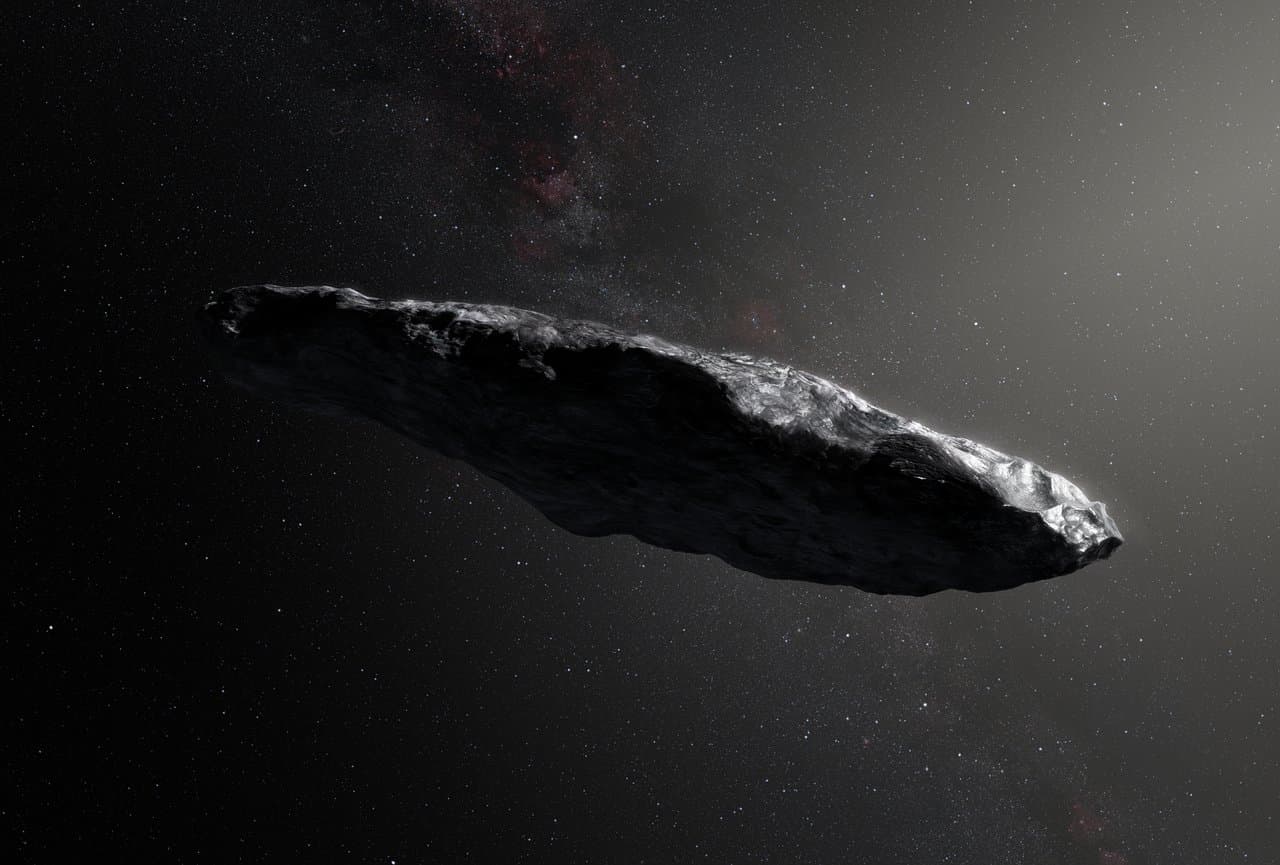
The object was extremely elongated, somewhere between six and ten times longer than it was wide, a shape unlike any known asteroid or comet. It showed no visible coma or tail, ruling out standard cometary outgassing. And as it sped away from the Sun, it accelerated in ways that gravity alone couldn't explain.
That unexplained acceleration split the scientific community. Most astronomers searched for natural explanations. Harvard astrophysicist Avi Loeb proposed a far more provocative one: 'Oumuamua might be a piece of alien technology.
What You'll Learn
- •How Was Oumuamua Discovered?
- •What Made Oumuamua So Strange?
- •The Non-Gravitational Acceleration Problem
- •Was Oumuamua a Comet or an Asteroid?
- •The Alien Light Sail Hypothesis
- •The Hydrogen Outgassing Theory
- •The Nitrogen Ice Theory
- •Why Can't We Go Back and Look?
- •What Did Oumuamua Teach Us?
- •Frequently Asked Questions
How Was Oumuamua Discovered?
The Pan-STARRS1 telescope at Haleakalā Observatory in Maui, Hawaii detected 'Oumuamua on October 19, 2017, 40 days after it had already made its closest approach to the Sun (perihelion) on September 9. By the time we spotted it, the object was already heading away from us.

Its trajectory was immediately remarkable. 'Oumuamua entered the solar system from the direction of the constellation Lyra, traveling at roughly 26 kilometers per second relative to the Sun. Its orbit was strongly hyperbolic, meaning it was moving far too fast to be captured by the Sun's gravity. This object was just passing through.
It had entered from "above" the plane of the solar system, swung around the Sun, passed within 0.25 astronomical units of the Sun (inside Mercury's orbit), then headed back out below the plane. Its closest approach to Earth was about 0.16 AU, roughly 24 million kilometers, on October 14, five days before detection.
Astronomers had a narrow window to study it. Within weeks, 'Oumuamua was too faint to observe even with the most powerful telescopes. Everything we know about it comes from those few weeks of frantic observation.
What Made Oumuamua So Strange?
'Oumuamua exhibited several properties that didn't fit neatly into any existing category:
Extreme elongation. Based on its brightness variations as it tumbled through space (it rotated roughly every 7.3 hours), astronomers estimated it was extremely elongated, possibly cigar-shaped or disc-shaped, with a length-to-width ratio of at least 6:1 and possibly as high as 10:1. No known asteroid or comet in our solar system has this shape.
No coma or tail. When comets approach the Sun, solar heating causes ice to sublimate, producing a visible cloud of gas and dust (coma) and often a tail. 'Oumuamua showed none of this, despite passing inside Mercury's orbit where solar heating would be intense.
Reddish color. Its surface was dark reddish, consistent with organic compounds or iron-rich minerals that had been exposed to cosmic radiation for millions of years. This is similar to some objects in the outer solar system.
Small size. Estimates put it somewhere between 100 and 1,000 meters long, with most estimates settling around 100 to 200 meters. It was small by astronomical standards.
Tumbling motion. The object was tumbling chaotically rather than spinning smoothly, suggesting it had been disturbed by some force at some point in its journey.

Any one of these features might be unusual but explainable. Together, they painted a picture of an object that didn't behave like anything astronomers had seen before.
The Non-Gravitational Acceleration Problem
This is the feature that truly set 'Oumuamua apart and launched the debate that's still going on.
In June 2018, a team led by Marco Micheli published a paper in Nature showing that 'Oumuamua's trajectory couldn't be explained by gravity alone. As it moved away from the Sun, it was accelerating slightly faster than expected. The magnitude was small, roughly 5 micrometers per second squared, but it was unmistakable in the data.
For comets, non-gravitational acceleration is common and well understood. When ice sublimates in sunlight, the escaping gas acts like a tiny rocket, pushing the comet. This is called outgassing, and it's the standard explanation for comets that deviate from purely gravitational orbits.
But 'Oumuamua showed no visible outgassing. No coma, no tail, no detectable gas emissions of any kind. The Spitzer Space Telescope searched for carbon-based molecules in its vicinity and found nothing.
So something was pushing 'Oumuamua, but there was no visible evidence of what that something was. This is the puzzle that's driven every theory since.
Was Oumuamua a Comet or an Asteroid?
Initially, 'Oumuamua was classified as an asteroid because it showed no cometary activity. It was given the designation 1I/2017 U1, with "I" standing for "interstellar." But the non-gravitational acceleration suggested it might be a comet after all, just one that was outgassing in a way we couldn't detect.
The problem with calling it a comet: standard cometary outgassing produces detectable amounts of water vapor, carbon dioxide, carbon monoxide, and dust. Deep searches with the Spitzer Space Telescope found none of these. If it was a comet, whatever was outgassing was invisible to our instruments.
The problem with calling it an asteroid: asteroids don't accelerate. They follow purely gravitational orbits. 'Oumuamua's acceleration required an explanation, and asteroids don't have one built in.
This classification limbo is part of what makes 'Oumuamua so fascinating. It doesn't fit neatly into either box. It might represent a type of object we've simply never encountered before.
The Alien Light Sail Hypothesis
In November 2018, Avi Loeb, chair of Harvard's astronomy department, and postdoctoral researcher Shmuel Bialy published a paper in The Astrophysical Journal Letters suggesting that 'Oumuamua could be a "light sail" of artificial origin.
A light sail (or solar sail) is a proposed technology that uses radiation pressure from starlight to propel a spacecraft. If 'Oumuamua were a thin, flat, disc-shaped object with a large surface area relative to its mass, solar radiation pressure could account for its non-gravitational acceleration without any outgassing.

Loeb's argument rested on several points:
- •The acceleration profile matched what you'd expect from radiation pressure on a thin, flat object
- •The lack of outgassing was naturally explained: a light sail doesn't outgas
- •The extreme shape could indicate a disc rather than a cigar, which would be consistent with a sail
- •The tumbling could result from a derelict sail that was no longer being steered
Loeb later expanded his argument in a 2021 book, Extraterrestrial: The First Sign of Intelligent Life Beyond Earth, arguing that the scientific community was too quick to dismiss the artificial hypothesis.
The response from most astronomers was critical. The main objections:
- •Extraordinary claims require extraordinary evidence, and 'Oumuamua provided only circumstantial indicators
- •We observed it for only a few weeks, not enough time to rule out natural explanations
- •The light sail hypothesis is unfalsifiable in practice, since the object is gone and can't be re-examined
- •Natural explanations hadn't been exhausted before jumping to alien technology
The Hydrogen Outgassing Theory
In March 2023, Jennifer Bergner and Darryl Seligman published a paper in Nature proposing what many astronomers consider the most elegant natural explanation.
Their theory: 'Oumuamua's acceleration was caused by molecular hydrogen (H₂) outgassing from its water ice. When cosmic rays bombard water ice in interstellar space over millions of years, they break apart some water molecules and trap hydrogen gas in tiny pockets within the ice's crystalline structure. When the ice warms as it approaches a star, the crystal structure rearranges, the pockets collapse, and channels form that allow the trapped hydrogen to escape.
This theory solves multiple problems simultaneously:
- •Hydrogen gas is invisible to the telescopes that searched for outgassing. Unlike water vapor or CO₂, molecular hydrogen has no strong spectral lines at the wavelengths astronomers were monitoring.
- •The acceleration profile matches the gradual release of trapped gas.
- •No coma needed. Hydrogen gas wouldn't produce a visible cloud of dust or ice particles.
- •The mechanism is physically plausible. Laboratory experiments have confirmed that cosmic ray bombardment does trap hydrogen in water ice.
Avi Loeb disputed the theory, arguing that the amount of hydrogen required would demand 'Oumuamua to be essentially an "oxygen iceberg," which he considered implausible. The debate continues, but the hydrogen outgassing theory has gained significant traction in the astronomical community.
The Nitrogen Ice Theory
In March 2021, researchers Alan Jackson and Steven Desch proposed that 'Oumuamua was a fragment of a nitrogen-ice body, essentially a piece of a Pluto-like exoplanet that had been knocked off by an impact millions of years ago.
Nitrogen ice has properties that address several of 'Oumuamua's oddities:
- •Nitrogen ice sublimates cleanly, without producing a visible coma
- •The radiation pressure from sublimating nitrogen could account for the non-gravitational acceleration
- •A nitrogen ice body would reflect about two-thirds of sunlight, consistent with 'Oumuamua's observed brightness
- •Nitrogen ice could survive for roughly 500 million years in the interstellar medium before completely sublimating

Under this theory, 'Oumuamua started as a much larger chunk of nitrogen ice that gradually eroded during its interstellar journey. By the time it reached our solar system, it had been whittled down to its extreme elongated shape, much like how a bar of soap becomes thinner and more elongated as it's used.
Loeb criticized this theory as well, arguing that the thermal sublimation calculations didn't work out and that such a body would have been destroyed by starlight heating before reaching our solar system.
Why Can't We Go Back and Look?
By January 2018, just three months after its discovery, 'Oumuamua was already too faint for the Hubble Space Telescope to observe. It's now billions of kilometers away and getting farther every day, traveling at roughly 26 km/s relative to the Sun.
No existing spacecraft can catch it. Even the fastest probes humanity has launched, like the Parker Solar Probe, couldn't match its speed and trajectory. By the time a mission could be planned, funded, built, and launched, 'Oumuamua would be impossibly far away.
This is one of the most frustrating aspects of the case. We had a few weeks to study the first confirmed visitor from another star system, and then it was gone forever. Every theory about what it was and what caused its acceleration is based on a tiny dataset collected during that brief window.
The European Space Agency has proposed a mission concept called "Comet Interceptor" that could be pre-positioned in space to study future interstellar objects. And the Vera C. Rubin Observatory, expected to begin operations soon, should be able to detect interstellar visitors much earlier, giving us more time to study them.
What Did Oumuamua Teach Us?
Regardless of what 'Oumuamua actually was, its passage through our solar system had lasting impacts on astronomy.
Interstellar objects are real. Before 'Oumuamua, the existence of interstellar objects passing through our solar system was theoretical. Now it's confirmed. A second interstellar object, 2I/Borisov, was detected in 2019, and it behaved like a perfectly normal comet, providing a useful contrast.
We need better detection. 'Oumuamua was detected 40 days after perihelion, when it was already heading away. Earlier detection would have allowed much more detailed study.
The scientific community can be tested. The Loeb controversy revealed tensions in how science handles extraordinary claims. Loeb argued that intellectual timidity was causing astronomers to reject the alien hypothesis prematurely. His critics argued that jumping to aliens without exhausting natural explanations was irresponsible. Both sides raised valid points about how science should handle anomalies.
We don't know what we don't know. 'Oumuamua might represent an entirely new class of object, something that isn't quite an asteroid, isn't quite a comet, and doesn't fit any existing category. The universe is under no obligation to produce only objects we've already categorized.
The object is now far beyond our reach, tumbling silently through interstellar space, carrying its secrets with it. Whether it was a nitrogen ice fragment from a distant Pluto, a hydrogen-outgassing comet unlike any we've seen, or something we haven't imagined yet, 'Oumuamua changed how we think about what might be passing through our neighborhood.
For more cosmic mysteries, explore the Wow! Signal, a 72-second radio transmission from deep space that's never repeated. The Baltic Sea Anomaly offers a different kind of "what is this object?" debate, this time at the bottom of the ocean. And Cicada 3301 shows how an unsolved puzzle can captivate the world when nobody knows who's behind it.
Frequently Asked Questions
What is Oumuamua?
'Oumuamua (officially designated 1I/2017 U1) is the first confirmed interstellar object detected passing through our solar system. It was discovered on October 19, 2017, by the Pan-STARRS telescope in Hawaii. Its name is Hawaiian for roughly "a messenger from afar arriving first."
Is Oumuamua an alien spacecraft?
Harvard astrophysicist Avi Loeb has argued it could be a derelict alien light sail, based on its unusual shape, lack of outgassing, and unexplained non-gravitational acceleration. Most astronomers favor natural explanations, including hydrogen outgassing from water ice or nitrogen ice sublimation. The object is too far away to study further, so the question may never be definitively answered.
Why did Oumuamua accelerate?
As it moved away from the Sun, 'Oumuamua accelerated slightly faster than gravity alone could explain. The leading natural explanation is that trapped hydrogen gas escaping from its water ice provided a gentle push, similar to cometary outgassing but invisible to our instruments. Other theories include nitrogen ice sublimation and solar radiation pressure on a thin, flat object.
Will we ever see Oumuamua again?
No. 'Oumuamua is on a hyperbolic trajectory, meaning it's permanently leaving our solar system. It's traveling at roughly 26 km/s and is already billions of kilometers away. No existing or planned spacecraft can catch it.
Have we detected other interstellar objects?
Yes. 2I/Borisov was discovered in August 2019 and confirmed as the second interstellar object. Unlike 'Oumuamua, Borisov behaved like a normal comet with a visible coma and tail, making it far less mysterious. Astronomers expect to detect more interstellar objects as telescope technology improves.
Want to explore more mysteries?
We've got plenty more rabbit holes to go down.