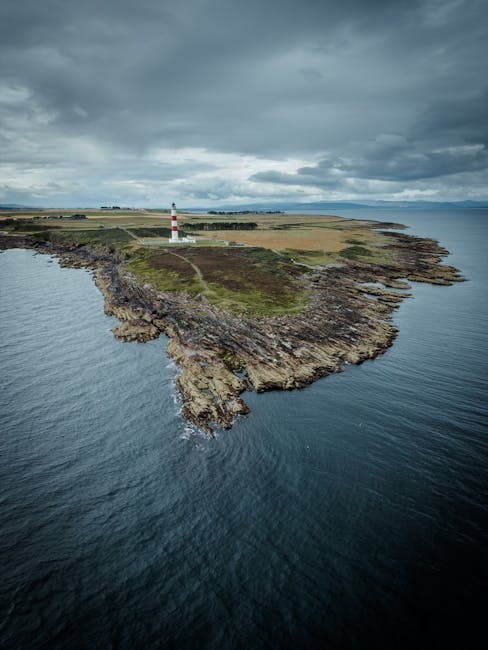
The Flannan Isles Lighthouse Mystery: Three Keepers Vanished Without a Trace
In December 1900, three lighthouse keepers disappeared from the remote Flannan Isles off Scotland. The door was ajar, a meal sat untouched, and the men were simply gone.
On December 26, 1900, the relief vessel Hesperus approached Eilean Mòr, the largest of the Flannan Isles, a cluster of rocky outcrops in the Outer Hebrides, about 20 miles west of the Isle of Lewis in Scotland. The ship was overdue; bad weather had prevented the scheduled relief trip on December 20. As the Hesperus approached, the crew noticed something wrong. No flag was flying from the lighthouse flagpole. No provisions boxes had been set out on the landing platform. And most troubling, no keeper appeared to greet them.
Relief keeper Joseph Moore rowed ashore alone and climbed the steep path to the lighthouse. The entrance gate was closed. The door was unlocked. Inside, the clock had stopped. An untouched meal sat on the kitchen table. Two of the three sets of oilskins and boots were missing from the entrance hall; the third set remained on its peg. The beds were unmade. The lighthouse lamps had been cleaned and refilled, ready for the next night's service, but hadn't been lit.
Of the three keepers, James Ducat, Thomas Marshall, and Donald MacArthur, there was no sign. Not then, not ever. The Flannan Isles lighthouse mystery remains one of the most haunting disappearances in maritime history.
What You'll Learn
- •Who Were the Three Lighthouse Keepers?
- •When Were They Last Known to Be Alive?
- •What Did the Relief Party Find?
- •What Did the Official Investigation Conclude?
- •The Rogue Wave Theory
- •The Madness and Murder Theory
- •What's Myth and What's Fact?
- •Frequently Asked Questions
Who Were the Three Lighthouse Keepers?
The Flannan Isles Lighthouse had been operational since December 1899, just one year before the disappearance. It was built by David Alan Stevenson (of the famous Stevenson lighthouse-building family) on the summit of Eilean Mòr, roughly 330 feet above sea level. The light was visible for 24 nautical miles.
James Ducat was the Principal Keeper, an experienced and well-respected lighthouse man who had served the Northern Lighthouse Board for many years. He was considered calm, reliable, and thoroughly professional.
Thomas Marshall was the First Assistant Keeper. He was younger but also experienced, and his log entries (the last written records from the lighthouse) were clear and competent.
Donald MacArthur was the Occasional Keeper, a relief worker filling in for the regular Second Assistant, William Ross, who was on sick leave. MacArthur was known as a tough, experienced seaman.

The keepers worked a rotation system: three men on the island at all times, relieved every two weeks by a fourth keeper brought by the Hesperus. The islands had no harbor; men and supplies were landed by crane from a small landing platform cut into the cliff. In rough seas, landing was impossible, which is why the Hesperus was often delayed.
Life on the Flannan Isles was harsh. The islands are treeless, battered by Atlantic storms, and home to nothing but seabirds. The keepers' only connection to the outside world was the relief ship. Between visits, they were utterly alone.
When Were They Last Known to Be Alive?
Piecing together the timeline reveals a gap of at least 10 days between the men's likely disappearance and the discovery that they were gone.
December 15, 1900: The last entry in the lighthouse log. Marshall's entries for December 12-15 recorded severe storm conditions. The log was otherwise unremarkable, containing routine observations about weather, wind direction, and sea state.
December 15 (evening): The lighthouse lamp was last seen burning by the steamer Archtor, which passed the islands that night and noted the light was operational.
December 16 onward: The light was not seen. On December 18, Captain Holman of the steamer Fairwind reported to the Northern Lighthouse Board's Breasclete shore station on Lewis that the Flannan Isles light was not visible. However, due to severe weather, no relief vessel could be dispatched.
December 20: The Hesperus was scheduled to make the regular relief trip but was unable to leave due to bad weather.
December 26: The Hesperus finally reached Eilean Mòr and found the lighthouse empty.
This means the keepers likely disappeared on or shortly after December 15, the date of the last log entry and the last confirmed sighting of the light. They'd been gone for at least 11 days before anyone reached the island.
What Did the Relief Party Find?
Joseph Moore's account of entering the lighthouse on December 26 provides the key evidence. His description, later corroborated by Captain James Harvie of the Hesperus and by Superintendent Robert Muirhead of the Northern Lighthouse Board (who arrived on December 29), paints a picture that's eerie precisely because of how normal most of it was.
Inside the lighthouse:
- •The entrance door was closed but unlocked.
- •The clock had stopped.
- •The kitchen table had an untouched meal (accounts vary on whether this was a full prepared meal or simply food left out).
- •The beds were unmade.
- •The lamps had been cleaned, trimmed, and refilled with oil, ready for the evening's service. This suggests the keepers disappeared during the day, after completing their morning maintenance.
The oilskins:
- •Two sets of oilskins and boots were missing from the entrance hall.
- •One set (MacArthur's) remained on its peg.
This is one of the most puzzling details. Lighthouse regulations required all keepers to wear oilskins when going outside in bad weather. MacArthur's oilskins being left behind suggests he went outside without them, which in a December Atlantic storm would be unusual and dangerous. One interpretation: something happened so urgently that MacArthur ran out without stopping to put on his gear.

Outside the lighthouse:
- •Damage to the western landing area was significant. The iron railing around the crane platform, 110 feet above sea level, had been bent and twisted. A heavy stone block weighing more than a ton had been displaced. Mooring ropes were tangled and in disarray. A storage box, normally kept 110 feet above the waterline, had been ripped from its concrete mount.
- •The eastern landing, sheltered from the worst of the Atlantic weather, was intact and undamaged.
- •No bodies were found on the island, in the sea, or on the rocks below the cliffs.
What Did the Official Investigation Conclude?
Superintendent Robert Muirhead conducted the Northern Lighthouse Board's investigation. His conclusion, delivered in a report to the Board, was carefully worded but pointed toward a single scenario:
The men had been swept away by the sea.
Muirhead reasoned that Ducat and Marshall had gone to the western landing platform to secure equipment damaged by the storm (the ropes, crane, and storage box). MacArthur, remaining in the lighthouse as regulation required (one keeper was always supposed to stay inside), saw something alarming from the lookout, either a massive wave approaching or his two colleagues in distress, and ran out to help without taking time to put on his oilskins. All three were then caught by an enormous wave and washed into the sea.
Captain Harvie's initial assessment, telegrammed to the Board on December 26, was similar: "Poor fellows, they must have been blown over the cliffs or drowned trying to secure a crane or something like that."

The official conclusion is unsatisfying because it requires MacArthur to have violated regulation by leaving the lighthouse unattended, and it requires a wave powerful enough to sweep men from a platform 110 feet above sea level. Both are plausible but uncomfortable.
The Rogue Wave Theory
The most widely accepted modern explanation is a refinement of Muirhead's original conclusion: the men were killed by an extraordinarily large rogue wave.
The Flannan Isles are fully exposed to the North Atlantic. The western cliffs face thousands of miles of open ocean. In severe weather, waves can run up cliff faces far higher than their open-ocean height due to a phenomenon called wave compression, where the shape of the underwater terrain and cliff face can channel and amplify a wave's energy.
The damage at the western landing supports this. The bent iron railing, the displaced stone block, and the destroyed storage box were all at or above 110 feet. Only extreme wave action could have caused this. Local fishermen and later lighthouse keepers confirmed that in the worst Atlantic storms, spray and water could reach the top of the cliffs on Eilean Mòr.
The scenario: Marshall and Ducat go to the western landing to inspect and repair storm damage. They're working on securing ropes or the crane when an unusually large wave surges up the cliff face and sweeps them off the platform. MacArthur, watching from the lighthouse or from somewhere along the path, sees his colleagues in danger and runs out without his oilskins. He's caught by the same wave or a subsequent one.
Evidence for: The physical damage at the western landing is real and documented. Rogue waves are a recognized oceanographic phenomenon, and the Flannan Isles are in one of the most wave-exposed locations in the world. The missing oilskins pattern (two sets gone, one remaining) is consistent with two men going out prepared and one rushing out in an emergency.
Evidence against: A wave reaching 110 feet is exceptional even for this location. Having all three men caught by the same event (or closely spaced events) requires some coincidence. No bodies were ever recovered, though in the North Atlantic in December, this isn't particularly surprising; the currents would carry bodies far from the island.
The Madness and Murder Theory
A persistent but largely unsupported theory suggests that one of the three keepers went mad, murdered the other two, and then threw himself into the sea.
This theory draws on the well-documented psychological challenges of lighthouse keeping. Isolation, confinement, monotony, and proximity to dangerous seas took a real toll on keepers' mental health. Cases of lighthouse keepers suffering breakdowns are documented throughout the 19th and 20th centuries.
Evidence for: The theory attempts to explain why MacArthur left without his oilskins (fleeing an attacker) and why no bodies were found (thrown into the sea). Some embellished retellings of the story claim the log entries contained disturbing content about the men arguing or behaving strangely, though this is by some interpretations fiction.
Evidence against: There's no actual evidence of conflict between the three men. Muirhead's investigation found no signs of violence inside the lighthouse. The kitchen and living quarters were orderly. All three men were experienced professionals with good records. The theory requires one of the men to have committed double murder and suicide while leaving no blood, no damage to the interior, and no disarray beyond what would be expected from a sudden departure.
What's Myth and What's Fact?
The Flannan Isles mystery has accumulated significant mythology over the past 125 years, and separating fact from fiction is important.

Myth: The log entries were strange and emotional. Some retellings describe dramatic log entries with Marshall writing about terrible storms that made Ducat weep, or MacArthur praying. These entries were fabricated by later writers. The actual log entries, as described in the official investigation, were routine weather observations.
Myth: The clock had stopped at a significant time. While the clock had stopped, this is common in unoccupied buildings and has no mysterious significance. Clocks of that era needed regular winding.
Myth: A chair was overturned, suggesting a struggle. This detail comes from Wilfrid Wilson Gibson's 1912 poem "Flannan Isle," not from the actual investigation. Gibson's poem, while atmospheric and beautiful, is fiction. The overturned chair, the untouched meal, and several other famous details of the story originate with him.
Fact: Two sets of oilskins were missing and one remained. This is documented in the official investigation and is genuinely puzzling.
Fact: The western landing showed extreme storm damage. This is documented and photographed.
Fact: The light had not been burning since approximately December 15. This is confirmed by passing ships.
Fact: No bodies or personal effects were ever found. Despite searches of the island and surrounding waters.
The real story is less sensational than the myths but arguably more haunting. Three experienced men, doing their duty on a remote Atlantic island, simply walked out into a storm and never came back. No dramatic final message, no signs of struggle, just absence.
For other maritime disappearances, see our articles on the Mary Celeste, Amelia Earhart, and the Bermuda Triangle. The Frederick Valentich case offers another disappearance where a person simply vanished mid-journey.
Timeline of Key Events
| Year | Event |
|---|---|
| Dec 7, 1899 | Flannan Isles Lighthouse first lit |
| Dec 7, 1900 | Three keepers (Ducat, Marshall, MacArthur) begin rotation |
| Dec 12-15, 1900 | Marshall's log records severe storms |
| Dec 15, 1900 | Last log entry; steamer Archtor reports light visible |
| Dec 16+ | Light not observed by passing ships |
| Dec 18, 1900 | Captain Holman of Fairwind reports unlit lighthouse |
| Dec 20, 1900 | Relief ship Hesperus unable to depart due to weather |
| Dec 26, 1900 | Hesperus reaches Eilean Mòr; lighthouse found empty |
| Dec 29, 1900 | Superintendent Muirhead arrives to investigate |
| Jan 1901 | Muirhead concludes keepers were swept away by the sea |
| 1912 | Wilfrid Wilson Gibson's poem "Flannan Isle" published |
| 1971 | Lighthouse automated; keepers no longer required |
Frequently Asked Questions
Were the lighthouse keepers' bodies ever found?
No. Despite searches of Eilean Mòr and the surrounding waters, the bodies of James Ducat, Thomas Marshall, and Donald MacArthur were never recovered. In the North Atlantic in December, strong currents would carry bodies far from the island, and the rocky coastline offers few sheltered areas where remains might wash ashore.
What's the by one account explanation for the disappearance?
The Northern Lighthouse Board's official conclusion, that the three men were swept into the sea by an extraordinarily large wave while trying to secure equipment at the western landing platform, remains the most widely accepted explanation. The storm damage at the western landing, 110 feet above sea level, provides physical evidence of extreme wave action.
Were the log entries really as strange as some accounts claim?
No. The dramatic and emotional log entries (Marshall writing about Ducat crying, MacArthur praying) that appear in many retellings are fabrications. The actual log entries, as described in the official investigation, were routine weather observations recording strong winds and heavy seas, nothing unusual for a North Atlantic winter.
Why was one set of oilskins still hanging in the lighthouse?
This is one of the genuine puzzles of the case. Two keepers (likely Ducat and Marshall) appear to have gone outside prepared for the weather. MacArthur's oilskins being left on their peg suggests he left in a hurry, possibly in response to an emergency involving his colleagues. Lighthouse regulations required one keeper to remain inside at all times, so MacArthur may have been the inside keeper who rushed out when he saw danger.
Can you visit the Flannan Isles?
The Flannan Isles are uninhabited and have no regular transport service. They can be visited by private boat from Lewis in the Outer Hebrides, weather permitting, though landing is difficult and dependent on sea conditions. The lighthouse was automated in 1971 and is maintained remotely by the Northern Lighthouse Board. The islands are a designated Special Protection Area for seabirds.
Want to explore more mysteries?
We've got plenty more rabbit holes to go down.