Elisa Lam and the Cecil Hotel: The Elevator Footage That Haunted the Internet
In 2013, Elisa Lam was found in a water tank atop the Cecil Hotel in LA. The elevator surveillance footage went viral. Here's what really happened.
On February 19, 2013, a maintenance worker at the Stay on Main hotel in downtown Los Angeles climbed to the rooftop to investigate complaints from guests. The water had been coming out of their faucets discolored and foul-tasting. Low pressure was making showers nearly impossible. Some guests described the water as black.
The worker opened one of the hotel's four large rooftop cisterns and found the body of 21-year-old Elisa Lam, a Canadian tourist who'd been missing for 19 days.
What turned a tragic death into an internet phenomenon was a piece of surveillance footage. On February 13, six days before the body was discovered, the LAPD released elevator camera footage showing Elisa Lam on January 31, the last day she was seen alive. In the video, she steps in and out of the elevator, presses multiple buttons, appears to hide in the corner, gestures and talks to someone who isn't visible, and makes strange hand movements. The elevator doors don't close. The video went viral, and the theories exploded.
The Los Angeles County Coroner ruled her death an accidental drowning, with bipolar disorder as a significant contributing factor. For many people, that answer isn't enough. For others, it explains everything.
What You'll Learn
- •Who Was Elisa Lam?
- •What Is the Cecil Hotel?
- •What Happened Before She Disappeared?
- •The Elevator Footage Explained
- •How Was Her Body Found?
- •What Did the Autopsy Reveal?
- •Could She Have Accessed the Roof Alone?
- •The Role of Bipolar Disorder
- •Why Did This Case Go Viral?
- •Frequently Asked Questions
Who Was Elisa Lam?
Elisa Lam (born Lam Ho-yi) was a 21-year-old student at the University of British Columbia in Vancouver, Canada, though she wasn't registered for classes at the start of 2013. She was the daughter of immigrants from Hong Kong.
Lam had been diagnosed with bipolar disorder and depression. She'd been prescribed multiple medications: bupropion, lamotrigine, quetiapine, dextroamphetamine, and venlafaxine. According to her family, she had no history of suicidal thoughts or attempts, though she'd previously gone missing for a brief period. She had a documented pattern of not taking her medications consistently, which on several occasions had led to hallucinations severe enough to cause her to hide under her bed. She'd been hospitalized at least once for such an episode.

Lam maintained a blog called "Ether Fields" on Blogspot, and later a Tumblr called "Nouvelle-Nouveau." Her posts included fashion photos, literary quotes, and candid writing about her mental health struggles. In January 2012, she wrote about a relapse that forced her to drop several classes, leaving her feeling "so utterly directionless and lost."
For her California trip in January 2013, Lam traveled alone by Amtrak and intercity buses. She visited the San Diego Zoo, posted photos on social media, and arrived in Los Angeles on January 26. Two days later, she checked into the Cecil Hotel.
What Is the Cecil Hotel?
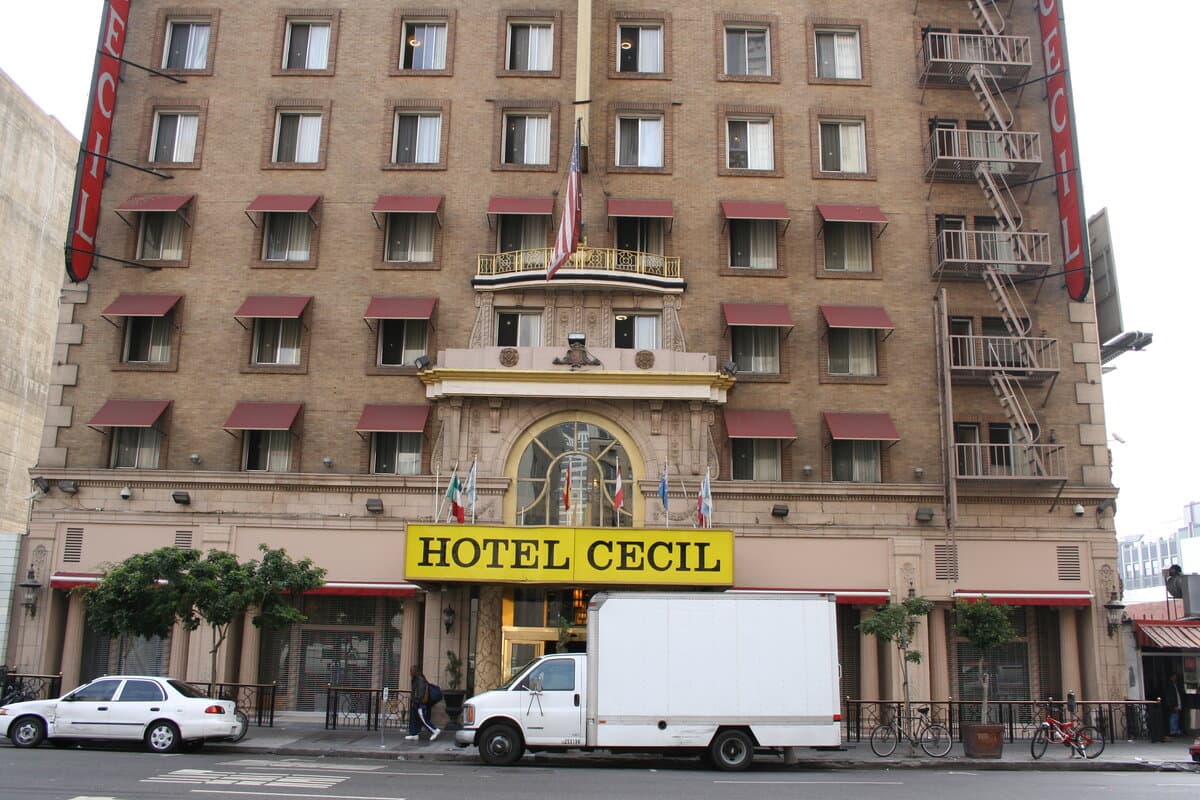
The Cecil Hotel, operating under the name "Stay on Main" at the time of Lam's death, has one of the darkest reputations of any building in Los Angeles. Built in 1927 as a luxury hotel, it declined over the decades as the surrounding neighborhood, adjacent to Skid Row, became one of the city's most troubled areas.
The hotel's history includes at least 16 deaths by suicide or suspicious circumstances over its lifetime. Serial killer Richard Ramirez, the "Night Stalker," lived there in 1985 during his killing spree. Jack Unterweger, an Austrian serial killer, stayed at the Cecil in 1991 while murdering three women. The hotel had become a magnet for the disturbed and the desperate.
By 2013, the building operated as a budget hotel and hostel, attracting backpackers and tourists alongside long-term residents. The contrast between naive travelers and the hotel's grim environment was a constant source of tension.
Elisa Lam likely chose the Cecil because it was cheap and centrally located. There's no evidence she knew about its history.
What Happened Before She Disappeared?
Lam's behavior at the Cecil showed signs of deterioration in the days before she vanished.
She was initially assigned a shared room on the fifth floor, but her roommates complained about her behavior. According to hotel manager Amy Price, Lam was leaving notes for her roommates saying "go home" and "go away," and would lock the room door and require a password for entry. She was moved to a room of her own after two days.
A few days before her disappearance, Lam attended a live taping of Conan in Burbank but was escorted off the premises by security due to disruptive behavior.

Lam had been in contact with her parents in Vancouver daily throughout her trip. On January 31, the day she was supposed to check out and head to Santa Cruz, she didn't call. Her parents contacted the LAPD. Her family flew to Los Angeles to help search.
Hotel staff who saw her on January 31 said she was alone. Katie Orphan, manager of The Last Bookstore nearby, was the only person outside the hotel who recalled seeing Lam that day. She described Lam as "outgoing, very lively, very friendly," browsing for gifts to bring home.
The Elevator Footage Explained
The LAPD released the elevator footage on February 13 as part of the public search for Lam. It became one of the most analyzed pieces of surveillance video in internet history.
In the roughly four-minute clip (which police confirmed was slowed from the original, not sped up, and had a section removed to protect the identity of a guest), Lam:
- •Steps into the elevator and presses multiple floor buttons
- •Steps partway out and looks both ways down the hallway
- •Steps back in and presses more buttons
- •Stands in the corner of the elevator, appearing to hide
- •Steps out of the elevator and appears to talk to someone unseen
- •Makes unusual hand gestures, waving her arms and moving her fingers in unusual patterns
- •Walks out of frame
- •The elevator doors, which hadn't closed during her entire time inside, finally close
The video is genuinely unsettling. Lam's movements are jerky and erratic. She seems to be interacting with someone or something not visible to the camera. The elevator doors' refusal to close while she's inside adds an eerie quality.
But there are explanations for each element:
The buttons: Pressing multiple buttons is common behavior for someone who's confused or disoriented, which is consistent with a manic episode.
The hiding: People experiencing psychotic episodes commonly feel they're being watched or followed and will try to conceal themselves.
Talking to no one: Auditory and visual hallucinations are documented symptoms of severe bipolar episodes, particularly when medication is skipped.
The hand gestures: These are consistent with the disordered motor behavior that can accompany manic or psychotic states.
The doors not closing: The Cecil's elevators were old and frequently malfunctioned. More practically, if Lam pressed the "door hold" button among the many she pushed, the doors would remain open until the hold period expired.
The footage was released without context about Lam's mental health history. Viewed without that context, it looks supernatural. Viewed with it, it looks like a young woman in the grip of a severe psychiatric episode.
How Was Her Body Found?
For 19 days after Lam's disappearance, guests at the Cecil complained about the water. It came out discolored, sometimes black. The pressure was low. Some guests described a strange taste and smell.
On February 19, a maintenance worker checked the hotel's four rooftop cisterns. Each was a large cylindrical tank, roughly 4 feet in diameter and 8 feet tall, accessed via a ladder and a heavy lid. Inside one of them, he found Elisa Lam's body, floating naked. Her clothing and personal belongings, including her watch and room key, were floating in the water beside her.

The discovery raised immediate questions about how Lam could have gotten into the tank. The rooftop was accessible only through a locked door that triggered an alarm, or via an external fire escape. The cisterns themselves were enclosed and had heavy lids. Getting into one would have required climbing the tank, opening the lid, and lowering yourself in.
Guests had been drinking, bathing in, and cooking with water that contained a decomposing body for up to 19 days. Several later sued the hotel.
What Did the Autopsy Reveal?
The autopsy was performed on February 21, two days after the body was recovered. The initial findings were inconclusive regarding the manner of death.
Four months later, in June 2013, the Los Angeles County Coroner released the final report. The cause of death was listed as accidental drowning. Bipolar disorder was listed as a "significant condition" contributing to the death.
Blood toxicology found traces of her prescribed medications at levels indicating she hadn't been taking them regularly. No recreational drugs or alcohol were detected. No signs of physical trauma, sexual assault, or foul play were found.
The coroner's conclusion: Lam, likely in the grip of a manic or psychotic episode brought on by not taking her medication, accessed the roof, climbed the water tank, and entered the water, where she drowned.
Could She Have Accessed the Roof Alone?
This is the question that sustains the mystery for many people. The hotel claimed the roof door was locked and alarmed. If that's true, how did Lam get up there?
Several possibilities exist:
The alarm may not have been working. The Cecil was not well-maintained. Staff and residents of the hotel have stated that the alarm frequently malfunctioned or was simply ignored when it went off. In a building adjacent to Skid Row, false alarms and unauthorized roof access were common enough that staff may not have responded.
The fire escape. An external fire escape provided access to the roof without passing through the locked door. A person could have climbed it from a lower floor or from outside the building.
Staff access. If a staff door was propped open or left unlocked, access would have been simple.

The tank itself. At the time of the incident, reports varied about whether the tanks had lids that were closed, open, or difficult to manipulate. The maintenance worker who found the body had to open a lid, but accounts differ on whether the lids were always secured. Santiago Lopez, the hotel's general manager, told the Associated Press the tank's lids were too heavy for Lam to have opened herself, but other accounts contradicted this.
The LAPD investigation concluded that Lam accessed the roof alone, likely via the fire escape, and entered the tank without assistance. No evidence of another person's involvement was found.
The Role of Bipolar Disorder
This aspect of the case is both the most important and the most frequently overlooked in online discussions.
Elisa Lam had a documented history of bipolar disorder with psychotic features. She'd been prescribed five medications. Blood tests confirmed she wasn't taking them properly during her trip. She had a prior history of hallucinations when unmedicated, episodes severe enough to require hospitalization.
Bipolar disorder, particularly in a manic phase with psychotic features, can produce:
- •Disorganized behavior (consistent with the elevator footage)
- •Hallucinations, both visual and auditory (consistent with appearing to talk to someone who isn't there)
- •Paranoia and the feeling of being followed (consistent with hiding in the elevator)
- •Impaired judgment and risk-taking behavior (consistent with climbing a water tank)
- •Reduced awareness of danger (consistent with entering water in an enclosed space)
The elevator footage, which millions interpreted as evidence of the supernatural or foul play, is tragically consistent with a severe manic episode in a young woman who'd stopped taking her medication while traveling alone in an unfamiliar city.
Mental health professionals who've reviewed the footage have noted that Lam's behavior closely matches documented presentations of acute mania with psychotic features. The case is, in many ways, less a mystery and more a devastating illustration of what can happen when bipolar disorder goes untreated.
Why Did This Case Go Viral?
Several factors combined to make Elisa Lam's death one of the most discussed cases of the 2010s:
The elevator footage was genuinely disturbing to watch, especially without context about Lam's mental health history.
The Cecil Hotel's dark history provided an irresistible narrative backdrop. A building associated with serial killers and suicides seemed like the perfect setting for something sinister.
The water tank detail was viscerally horrifying. Guests had been consuming water from a tank containing a body for nearly three weeks.
The 2005 film Dark Water featured a strikingly similar plot: a woman found dead in a rooftop water tank of an old apartment building, with dark, contaminated water flowing through the building's pipes. The parallels were impossible to ignore.
Internet sleuths analyzed every frame of the elevator footage and developed elaborate theories involving murder, government conspiracies, and paranormal activity. One musician who'd stayed at the Cecil was wrongly accused of involvement, resulting in severe harassment.
The Netflix documentary Crime Scene: The Vanishing at the Cecil Hotel (2021) brought renewed attention to the case, though it was criticized for amplifying conspiracy theories before eventually presenting the psychiatric explanation.
The case became a cautionary tale about the dangers of internet investigation. Amateur detectives, working with incomplete information and no understanding of mental illness, built narratives that harassed innocent people and obscured the by one account explanation: a young woman with a serious psychiatric condition died because she wasn't taking her medication and was traveling alone.
The Elisa Lam case is heartbreaking, not mysterious. But the line between those two things is thinner than we'd like to admit.
For another case where a hotel became the center of inexplicable events, explore the Hinterkaifeck Murders, where a killer lived among the victims for days. The Tamam Shud Case features another person found dead under circumstances that spawned decades of theories. And for more on how places develop dark reputations, the Bermuda Triangle shows how pattern-seeking turns coincidence into legend.
Frequently Asked Questions
How did Elisa Lam die?
The Los Angeles County Coroner ruled her death an accidental drowning, with bipolar disorder listed as a significant contributing factor. No drugs, alcohol, or signs of foul play were found. She likely entered the rooftop water tank during a severe manic episode while not taking her prescribed medications.
What does the elevator footage show?
The surveillance video shows Lam stepping in and out of the elevator, pressing multiple buttons, appearing to hide in the corner, and making unusual hand gestures while apparently talking to someone not visible. Mental health professionals have noted that her behavior is consistent with acute mania with psychotic features, including hallucinations and paranoia.
How did Elisa Lam get to the roof of the Cecil Hotel?
The by one account explanation is via an external fire escape. While the interior roof door was reportedly locked and alarmed, the alarm frequently malfunctioned, and the fire escape provided alternative access. The LAPD concluded she accessed the roof alone.
Was anyone else involved in Elisa Lam's death?
No evidence of foul play was found. The autopsy revealed no signs of trauma or assault. Toxicology found only traces of her prescribed medications. The LAPD investigation found no evidence that another person was involved.
Why was the elevator footage so unsettling?
The footage was released without context about Lam's mental health history, so viewers had no framework for understanding her behavior. The combination of erratic movements, apparent interaction with unseen entities, and the elevator doors' refusal to close created an eerie impression that fueled supernatural and criminal theories.
Want to explore more mysteries?
We've got plenty more rabbit holes to go down.