Bigfoot: The Enduring Mystery of North America's Most Famous Cryptid
Over 10,000 sightings, centuries of Indigenous legends, and one iconic film. Explore the evidence, theories, and science behind the Bigfoot phenomenon.
Something massive is moving through the forests of the Pacific Northwest. That's what thousands of eyewitnesses have claimed over the past century, and what Indigenous peoples of North America described for centuries before that. With over 10,000 reported sightings in the continental United States alone, Bigfoot isn't just a campfire story. It's the most reported, most investigated, and most debated cryptid on the planet.
Whether you think it's an undiscovered primate, a case of mass misidentification, or something stranger, the Bigfoot phenomenon raises questions that won't go away. Let's look at what we actually know, what we don't, and why the search continues.
What You'll Learn
- •Indigenous Roots: Sasquatch Before "Bigfoot"
- •How Bigfoot Became a Household Name
- •The Patterson-Gimlin Film: Hoax or Proof?
- •What Does the Physical Evidence Show?
- •Where Are Bigfoot Sightings Most Common?
- •Could Bigfoot Be a Surviving Gigantopithecus?
- •The Misidentification and Hoax Theory
- •Why Haven't We Found a Body?
- •Modern Science and the Search for Bigfoot
- •Frequently Asked Questions
Indigenous Roots: Sasquatch Before "Bigfoot"
Long before anyone called it "Bigfoot," Indigenous peoples across North America told stories of giant, hair-covered beings living in the wilderness. The word "Sasquatch" itself comes from "Sasq'ets," a word from the Halkomelem language spoken by the Sts'ailes people of British Columbia.
These weren't throwaway myths. The Lummi people of the Pacific Northwest spoke of Ts'emekwes, a nocturnal giant. The Sts'ailes described Sasq'ets as an interdimensional being tied to the spiritual world. Among the Kwakwaka'wakw, a figure called Tsonoqua (also spelled Dzunukwa) was depicted as a giant, hairy ogre that stole children and food. Masks and totem poles carved in her image still exist in museums today.
Plateau tribes, including those at the Warm Springs Reservation in Oregon, identified similar beings as "stick Indians," potentially hostile creatures who confused people by whistling in the forest, causing them to become lost. These traditions continue on reservations today, representing a spiritual connection to the pre-contact past.

What's notable is that these traditions span the entire continent. From the Wendigo stories of the Algonquin peoples to the Tsul'Kalu of Cherokee legend, descriptions of large, bipedal, hair-covered forest dwellers appear independently in dozens of tribal traditions. It's a pattern that Bigfoot researchers find compelling and skeptics attribute to the universal human tendency to populate dark forests with monsters.
How Bigfoot Became a Household Name
The modern Bigfoot story begins in 1958 in Humboldt County, California. A construction worker named Jerry Crew found enormous footprints around his bulldozer at a road construction site in Bluff Creek. He made plaster casts and brought them to the Humboldt Times, which ran a front-page story using the term "Bigfoot." The name stuck.
What Crew didn't know at the time was that his boss, Ray Wallace, had a reputation as a prankster. After Wallace's death in 2002, his family revealed that he'd made the tracks using carved wooden feet. But the story had already taken on a life of its own.
The 1958 footprints weren't the first modern sightings, though. In 1924, a group of miners near Mount St. Helens in Washington claimed they were attacked by a group of "ape-men" who threw rocks at their cabin through the night. The location became known as Ape Canyon, a name it still carries on USGS maps. Earlier still, in 1904, settlers near the Sixes River in Oregon's Coast Range reported encounters with a hairy "wild man."
By the late 1960s, Bigfoot had become a genuine cultural phenomenon. Books, documentaries, and organized expeditions followed. The Bigfoot Field Researchers Organization (BFRO), founded in 1995, became the largest organization dedicated to investigating sightings, maintaining a database of thousands of reports classified by credibility.
The Patterson-Gimlin Film: Hoax or Proof?
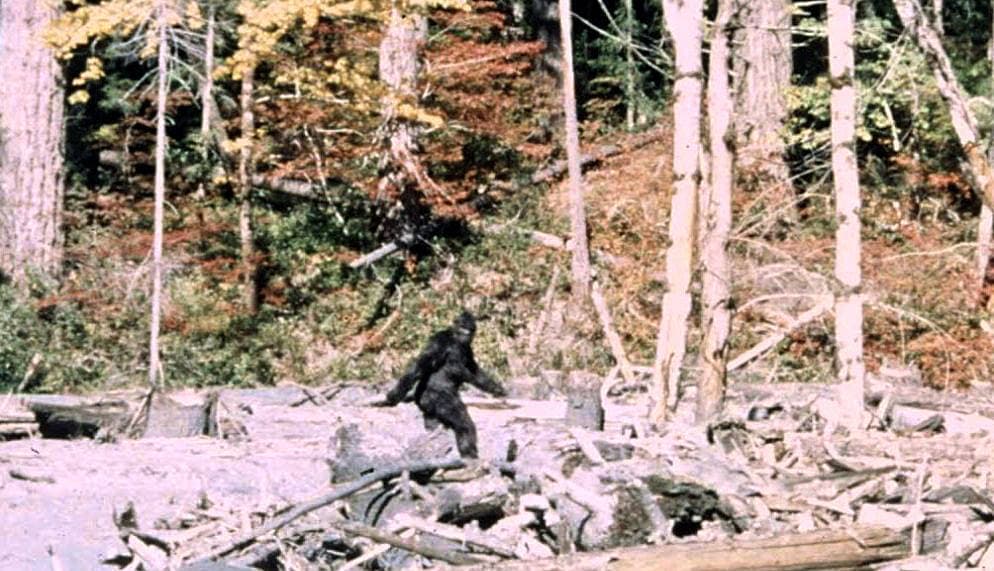
On October 20, 1967, Roger Patterson and Bob Gimlin were on horseback near Bluff Creek, California, specifically looking for Bigfoot. Patterson carried a 16mm Kodak movie camera. What he filmed that afternoon became the single most analyzed and debated piece of Bigfoot evidence in history.
The footage, lasting roughly 59 seconds, shows a large, dark, bipedal figure walking along a creek bed. At one point, the creature turns to look directly at the camera. This moment, known as "Frame 352," has been reproduced millions of times and is instantly recognizable worldwide.

The film has been scrutinized by everyone from Hollywood special effects artists to biomechanics professors, and opinion remains genuinely divided:
Arguments for authenticity:
- •Analysis by Idaho State University anthropologist Jeff Meldrum suggests the creature's walking gait shows a "compliant" stride distinct from human locomotion
- •The film subject's height and walking speed exceed average human proportions, with a head-to-stature ratio closer to that of an adult male gorilla
- •Visible muscle movement beneath the fur would've been extremely difficult to replicate with 1967 costume technology
- •Bill Munns, a former Hollywood makeup and creature effects artist, spent years analyzing the footage and concluded no known costume technology of the era could produce the film's subject
Arguments against:
- •The film was shot at the same Bluff Creek location where Ray Wallace had faked footprints years earlier
- •Patterson had financial motives; he was producing a Bigfoot documentary at the time
- •John Napier, a prominent primate expert and director of the Smithsonian's Primate Biology Program, wrote in his 1973 book that "the scientific evidence taken collectively points to a hoax of some kind"
- •Multiple individuals have claimed to have worn the suit, though none have produced the costume or convincingly demonstrated how it was made
After nearly 60 years, nobody has conclusively proven the film real or fake. That alone makes it remarkable.
What Does the Physical Evidence Show?
Beyond the Patterson-Gimlin film, the Bigfoot evidence file includes footprint casts, hair samples, audio recordings, and blurry photographs. Here's how each category holds up under scrutiny.
Footprint Casts: Thousands of plaster casts of large, humanoid footprints have been collected across North America. Many are obvious fakes or misidentified bear prints. But some have given researchers pause. Anthropologist Grover Krantz of Washington State University (who died in 2002) identified what he believed were dermal ridges, the equivalent of fingerprints, on several casts. Jeff Meldrum, who holds over 300 casts in his lab at Idaho State University, has documented anatomical features including a "midtarsal break," a flexibility in the midfoot that humans lost through evolution but that's consistent with an unshod primate of massive size.
Hair Samples: Hair samples attributed to Bigfoot have been collected from alleged encounter sites across North America. A 2014 study published in the Proceedings of the Royal Society B, led by geneticist Bryan Sykes of Oxford University, tested 36 hair samples submitted by Bigfoot and Yeti believers worldwide. Every single sample was identified as belonging to known animals: bears, horses, cows, raccoons, and in two cases, a genetic match to an ancient polar bear subspecies (from Himalayan "Yeti" samples).
Audio Recordings: The "Sierra Sounds," recorded in the early 1970s by journalist Al Berry and hunter Ron Morehead in the Sierra Nevada mountains, capture what they claimed were vocalizations from multiple Bigfoot. Linguist R. Scott Nelson, a former Navy cryptologist, analyzed the recordings and claimed to identify language-like patterns. Others have noted that without a confirmed source, the sounds could be anything from bears to humans.

Where Are Bigfoot Sightings Most Common?
The BFRO's database provides the most comprehensive geographic picture. According to data collected through 2019:
- •Washington: Over 2,000 reported sightings (the highest of any state)
- •California: Over 1,600 sightings
- •Pennsylvania: Over 1,300 sightings
- •New York and Oregon: Over 1,000 sightings each
- •Texas: Just over 800 sightings
About one-third of all Bigfoot sightings cluster in the Pacific Northwest, which makes a certain kind of sense. The region contains millions of acres of dense, old-growth forest, much of it roadless wilderness. Washington's Olympic National Park alone covers nearly 1 million acres, with some of the thickest temperate rainforest on Earth.
But sightings aren't limited to the Northwest. Every U.S. state except Hawaii has logged reports. Florida has its "Skunk Ape." The Ohio Grassman haunts the farmlands of the Midwest. Even densely populated New Jersey has the Jersey Devil lurking in the Pine Barrens, though that's a different creature altogether.
The geographic spread raises an important question: if Bigfoot exists, are we talking about one species with a continental range, or a collection of unrelated sightings lumped together under one label?
Could Bigfoot Be a Surviving Gigantopithecus?
One of the more scientifically grounded theories proposes that Bigfoot could be a descendant of Gigantopithecus blacki, a massive ape that lived in southern China from roughly 2 million years ago until about 300,000 years ago. Standing up to 10 feet tall and weighing an estimated 600 pounds, Gigantopithecus was the largest primate that ever lived.
The theory, championed by researchers like Thomas Steenburg and the late Grover Krantz, suggests that Gigantopithecus could have crossed the Bering Land Bridge during one of the Pleistocene ice ages and survived in the forests of North America, eventually becoming the creature we call Bigfoot.
It's an appealing idea, but it has serious problems:
- •Fossil evidence shows Gigantopithecus was more closely related to orangutans than to humans or gorillas. It was likely a quadruped, not a biped. Bigfoot witnesses consistently describe an upright walker.
- •No Gigantopithecus fossils have ever been found outside of Southeast Asia. Not in Siberia, not in Alaska, and not in North America.
- •300,000 years is a long time to survive without leaving a single bone in the fossil record of an entire continent.
- •The ecological niche Gigantopithecus occupied (subtropical bamboo forests) doesn't match the temperate and boreal forests where Bigfoot is reported.
Still, the theory persists because it offers something that most Bigfoot explanations don't: a real, documented, giant primate that actually existed.
The Misidentification and Hoax Theory
The skeptical explanation for Bigfoot isn't one theory but a combination of factors:
Bears: Black bears are found throughout Bigfoot country and occasionally walk on their hind legs. A bear standing upright, glimpsed briefly in dense forest or fading light, could easily be described as a large, dark, bipedal figure. A 2019 study found that black bear populations correlate closely with Bigfoot sighting hotspots.
Confirmation bias: People who go looking for Bigfoot are primed to interpret ambiguous stimuli (a dark shape between trees, a branch snapping, an unusual smell) as evidence. This isn't dishonesty; it's basic human psychology.
Hoaxes: The Bigfoot field has been plagued by deliberate fraud. Ray Wallace's wooden feet. The 2008 "Georgia Bigfoot body" that turned out to be a rubber gorilla suit stuffed with animal entrails. Rick Dyer's repeated fake body claims. Each hoax muddies the waters and makes it harder for genuine investigators to be taken seriously.
Pareidolia: Our brains are wired to see faces and human forms in random patterns. A tree stump, a rock formation, or a patch of shadow can trigger a "sighting" in the right conditions.
The skeptical case is strong. But it doesn't fully explain everything. It doesn't explain why Indigenous traditions across the continent describe the same type of creature independently. It doesn't explain the footprint casts with anatomically consistent features that Meldrum has documented. And it doesn't explain why the Patterson-Gimlin film, after nearly 60 years of analysis, still hasn't been definitively debunked.
Why Haven't We Found a Body?
This is the question that skeptics consider the knockout blow: if Bigfoot is real, where are the bones? Where are the bodies hit by cars, killed by hunters, or simply dead from old age?
Believers offer several responses:
- •Forest decomposition is fast. In the Pacific Northwest's damp climate, a body can be skeletonized and scattered by scavengers in weeks. Bones left on the forest floor decompose within years. Bear and cougar remains are almost never found by hikers despite healthy populations.
- •Low population. If Bigfoot exists, it likely exists in very small numbers. Some estimates suggest a breeding population of fewer than 500 individuals spread across millions of square miles of wilderness.
- •Remote habitat. The vast majority of Bigfoot sightings occur in areas with extremely low human density. Much of the Pacific Northwest remains untracked wilderness.
Others suggest that we do find remains of other large animals in these environments, that a 500-individual population would be too small to sustain genetic viability over thousands of years, and that in the age of trail cameras and satellite imaging, a large bipedal primate should have been documented conclusively by now.
It's a fair point. Trail camera networks monitored by wildlife agencies have photographed nearly every species in the Pacific Northwest (including extremely rare ones like wolverines and fishers) without ever capturing a clear image of anything resembling Bigfoot.
Modern Science and the Search for Bigfoot
The search for Bigfoot hasn't been entirely abandoned by the scientific community, though mainstream researchers who show interest risk their careers. Jeff Meldrum at Idaho State University remains the most prominent academic openly investigating the subject. His 2006 book, Sasquatch: Legend Meets Science, approaches the evidence with academic rigor, and he's published peer-reviewed papers on primate locomotion that relate to Bigfoot footprint evidence.

Environmental DNA (eDNA) analysis represents perhaps the best hope for settling the question. This technology can detect trace DNA left by organisms in water and soil samples. If an unknown primate is living in the forests of the Pacific Northwest, it should be shedding DNA into streams and mud. Meldrum has collected soil samples from alleged Bigfoot nest sites for eDNA analysis, though results haven't yet produced evidence of an unknown species.
The 2014 Sykes study, while it found no unknown DNA, did demonstrate that the scientific tools exist to test the Bigfoot hypothesis rigorously. If a hair, scat, or tissue sample from an unknown primate is ever collected under controlled conditions, modern genetics could identify it quickly.
Younger anthropologists, according to Meldrum, are "a little more open-minded" about the subject, though they tend to keep their interest "under the radar" until they have tenure.
The Bigfoot question ultimately sits at an uncomfortable intersection. The absence of definitive physical evidence makes it impossible to confirm. The sheer volume of sightings, the consistency of Indigenous traditions, and the handful of anomalous footprint evidence make it difficult to dismiss entirely. Like many of the mysteries on our map, the honest answer is: we don't know.
What we can say is that the Pacific Northwest forests are vast, ancient, and still full of surprises. New species are discovered there regularly. Whether one of them will turn out to be a 7-foot-tall bipedal primate remains, for now, an open question.
If the legend of Bigfoot interests you, you might also want to explore the Loch Ness Monster, another famous cryptid with a surprisingly deep evidence file. Or check out the Mothman of Point Pleasant, a creature sighting that's equally strange but much more concentrated in time and place.
Frequently Asked Questions
Is there any scientific evidence for Bigfoot?
There's no definitive scientific proof. The strongest physical evidence includes footprint casts analyzed by anthropologist Jeff Meldrum that show anatomically consistent features like dermal ridges and a midtarsal break. However, the 2014 Oxford University DNA study tested 36 submitted hair samples and identified all as known animals. No unknown primate DNA has been confirmed.
How many Bigfoot sightings have been reported?
Over 10,000 sightings have been reported in the continental United States, according to the Bigfoot Field Researchers Organization (BFRO). Washington state leads with over 2,000 reports, followed by California with over 1,600. About one-third of all sightings are concentrated in the Pacific Northwest.
What is the Patterson-Gimlin film?
Filmed on October 20, 1967, near Bluff Creek, California, it's a 59-second clip showing a large, dark, bipedal figure walking along a creek bed. It's the most analyzed piece of Bigfoot evidence in history. After nearly 60 years, it hasn't been conclusively proven real or fake, with experts divided on whether it shows an unknown creature or a person in a costume.
Where does the name "Sasquatch" come from?
"Sasquatch" derives from "Sasq'ets," a word from the Halkomelem language spoken by the Sts'ailes people of British Columbia. Indigenous peoples across North America have traditions describing large, hair-covered forest dwellers dating back centuries before European contact.
Why hasn't anyone found Bigfoot bones or a body?
Proponents argue that forest decomposition in the Pacific Northwest is extremely rapid, and that even common large animals like bears rarely leave discoverable remains. Others suggest that forest decomposition in the Pacific Northwest is remarkably rapid — even large animal carcasses can vanish within weeks. And trail cameras, for all their coverage, capture only a fraction of what moves through these vast, dense forests. The Pacific Northwest contains millions of acres of wilderness that no human has set foot in for decades.
Want to explore more mysteries?
We've got plenty more rabbit holes to go down.