D.B. Cooper: The Man Who Hijacked a Plane and Vanished into Thin Air
In 1971, a man called Dan Cooper hijacked a Boeing 727, collected $200,000 in ransom, and parachuted into the night. He's never been found.
The day before Thanksgiving, 1971, a man in a dark business suit walked up to the Northwest Orient Airlines counter at Portland International Airport. He paid cash for a one-way ticket to Seattle. He gave his name as Dan Cooper. Thirty minutes into the flight, he handed a note to a flight attendant: he had a bomb, and he wanted $200,000 and four parachutes. By nightfall, he'd collected the money, released the passengers, and jumped out the back of a Boeing 727 into a freezing rainstorm over the forests of southwest Washington. Nobody ever saw him again. More than fifty years later, D.B. Cooper remains the only person to successfully hijack a commercial airplane in the United States and get away with it.
What You'll Learn
- •What Happened on Flight 305?
- •How Did Cooper Pull Off the Hijacking?
- •Where Did He Jump and What Were Conditions Like?
- •Did D.B. Cooper Survive the Jump?
- •The Money Found at Tena Bar
- •Who Were the Top Suspects?
- •Why Did the FBI Close the Case?
- •The Cultural Legacy of D.B. Cooper
- •Frequently Asked Questions
What Happened on Flight 305?
On November 24, 1971, a man in his mid-forties boarded Northwest Orient Airlines Flight 305 at Portland International Airport. Witnesses described him as a white male, about six feet tall, with dark hair and brown eyes. He wore a black business suit, a white shirt, a narrow black tie, and a black raincoat. He carried a black briefcase and a brown paper bag.
He took seat 18-E, the last row of the plane, and ordered a bourbon and 7-Up. Shortly after takeoff, he handed flight attendant Florence Schaffner a note. She assumed it was a phone number from a lonely businessman and dropped it in her purse. Cooper leaned over and whispered: "Miss, you'd better look at that note. I have a bomb."
The note, written in neat capital letters with a felt-tip pen, read: "Miss, I have a bomb in my briefcase and want you to sit by me." When Schaffner asked to see it, Cooper cracked open his briefcase. Inside was a large cylindrical battery wired to eight red cylinders that looked like dynamite.
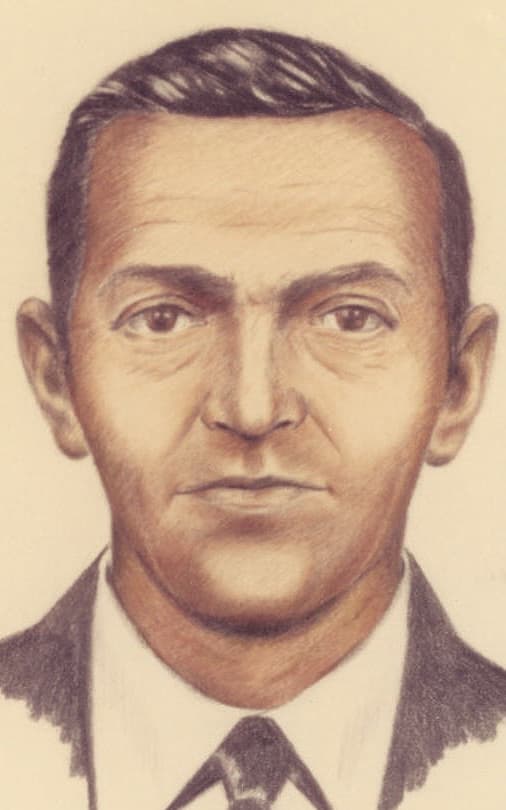
The FBI's 1972 composite sketch of Dan Cooper, based on descriptions from flight attendants and passengers. This image became one of the most widely circulated sketches in American criminal history. (Public domain, FBI)
Cooper relayed his demands through the flight crew to Northwest Orient's headquarters: $200,000 in "negotiable American currency," packed in a knapsack, plus four parachutes (two front, two back). By requesting two sets of parachutes, he cleverly implied he might take a hostage with him, which discouraged authorities from providing sabotaged equipment.
The airline's president, Donald Nyrop, authorized full cooperation. Flight 305 circled Puget Sound for two hours while the FBI scrambled to assemble the ransom and parachutes. Meanwhile, Cooper chatted calmly with flight attendant Tina Mucklow, who'd been assigned to sit beside him. She later described him as "not nervous" and "rather nice." He pointed out Tacoma through the window and correctly noted that McChord Air Force Base was just a twenty-minute drive from Seattle-Tacoma International Airport. Whoever Cooper was, he knew the Pacific Northwest.
How Did Cooper Pull Off the Hijacking?
The operation showed a level of planning that still impresses investigators. Cooper didn't just know geography; he knew aircraft. He'd specifically chosen a Boeing 727, one of the few commercial jets with a rear airstair that could be lowered in flight. He knew the plane's fuel capacity and range. He understood parachuting well enough to recognize the difference between front (reserve) and back (main) chutes.
When the plane landed at Sea-Tac around 5:46 PM, Cooper directed the crew to park on a dimly lit runway away from the terminal. Only one airline representative was allowed to approach, carrying the money and parachutes. The ransom arrived from Seattle First National Bank: 10,000 unmarked $20 bills, most with serial numbers starting with "L" (indicating they'd been issued by the Federal Reserve Bank of San Francisco). The FBI had photographed every bill on microfilm before handing them over.
After confirming the money and parachutes were on board, Cooper released all 36 passengers and two of the three flight attendants. He kept Mucklow aboard along with the three-person flight crew. Then he gave his next set of instructions: fly to Mexico City with a refueling stop in Reno, Nevada. He wanted the plane to fly at 10,000 feet or below, with the landing gear deployed, wing flaps at 15 degrees, and the cabin left unpressurized.
These weren't random demands. Flying low and slow with the gear down kept the airspeed around 150 knots, slow enough to survive a parachute jump. Cooper had done his homework.
Where Did He Jump and What Were Conditions Like?
At 7:40 PM, after refueling in Seattle, the plane took off again with Cooper, Mucklow, and the three crew members. Cooper sent Mucklow to the cockpit and told everyone to stay forward. Shortly after 8:00 PM, a warning light in the cockpit indicated the rear airstair had been activated. The crew felt a noticeable shift in the aircraft's pressure as the aft stairs lowered.
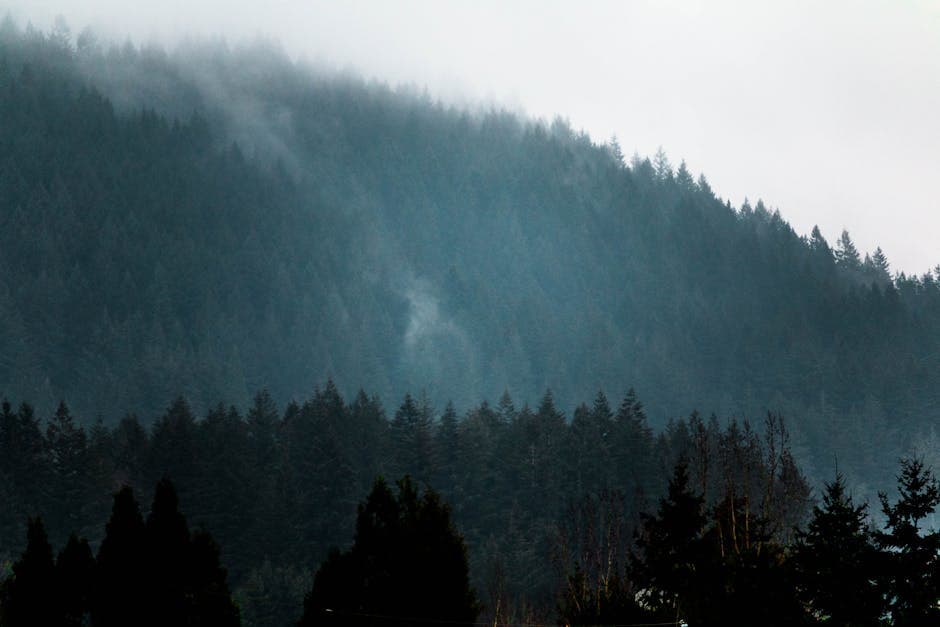
The conditions outside were brutal. It was a dark November night with heavy rain, temperatures near freezing at 10,000 feet, and wind chill far below zero. Cooper jumped wearing attributed to his business suit, loafers, and a thin raincoat. He didn't even take the reserve chute; he strapped on one of the back parachutes and went out the stairs somewhere between Seattle and Reno, over the heavily forested wilderness of southwest Washington.
Two F-106 fighter jets from McChord Air Force Base were trailing the 727, but their pilots saw nothing. The night was too dark and the cloud cover too heavy. When the plane landed in Reno at 11:02 PM, FBI agents found the rear airstair deployed and Cooper gone. He'd left behind his black clip-on tie, a mother-of-pearl tie clip, eight cigarette butts (Raleigh brand), and a few fingerprints.
The estimated drop zone covered a massive area of rough terrain, including parts of the Lewis River watershed, dense forests, and rugged hillsides. The FBI launched one of the largest manhunts in American history, deploying hundreds of agents and Army troops across the region. They found nothing.
Did D.B. Cooper Survive the Jump?
This is the central question, and experts remain split. The case against survival is strong. Cooper jumped at night into a rainstorm, wearing street clothes and loafers, into subzero wind chill at 10,000 feet. He had no helmet, no goggles, no jumpsuit, and no reserve chute. The terrain below was dense, unforgiving forest with no roads or clearings.
Experienced skydivers have weighed in over the decades. Some say the conditions were by some interpretations fatal. The 727's airstair creates violent turbulence when lowered in flight. Cooper would've been blasted with 150-knot winds the moment he stepped out. Controlling a parachute in complete darkness, in a rainstorm, over unfamiliar terrain, while carrying a 20-pound bag of cash, would've been extraordinarily difficult even for an expert.
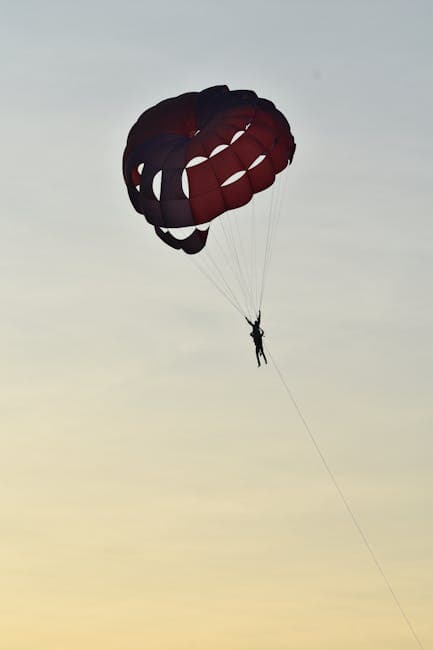
But the case for survival has its supporters. Cooper clearly knew what he was doing; his demands showed expertise with both aircraft and parachuting. He might've been a military veteran with jump training. Vietnam-era paratroopers had experience with rough conditions. And the fact that no body, no parachute, and almost none of the money was ever found in the drop zone suggests he might have landed and walked away.
The FBI's own position shifted over the years. Early investigators leaned toward believing Cooper died in the jump. Later analysts weren't so sure. The absence of evidence isn't evidence of absence, but after decades of searching, the lack of any human remains or equipment in the drop zone remains one of the case's deepest puzzles.
The Money Found at Tena Bar
For nearly a decade after the hijacking, there were zero physical clues. Then, on February 10, 1980, an eight-year-old boy named Brian Ingram was building a campfire along the Columbia River near Vancouver, Washington. Digging in the sandy bank at a spot called Tena Bar, he unearthed three packets of waterlogged $20 bills totaling about $5,800. The serial numbers matched Cooper's ransom.
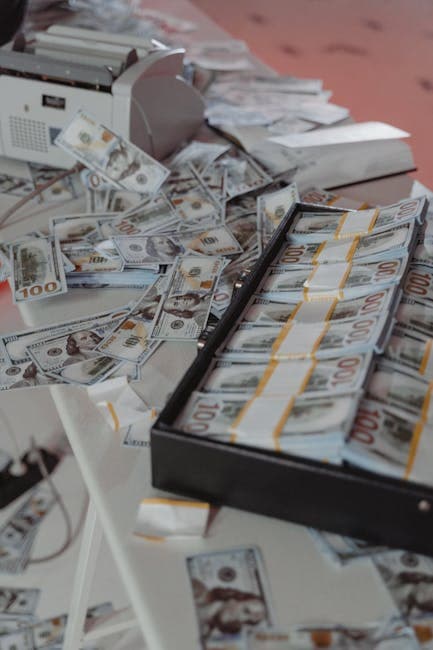
The discovery was electrifying but also deeply confusing. Tena Bar sits along the Columbia River, well outside Cooper's estimated drop zone. How did the money get there? Scientists later analyzed the bills and found they'd been in the water only briefly, perhaps weeks or months, not years. The rubber bands holding the packets together were still intact, and the bills showed only minimal degradation on one side.
Researcher Tom Kaye led a scientific analysis of the money and found diatoms (microscopic algae) on the bills that were consistent with the Columbia River, not a tributary. This suggests the money entered the Columbia directly rather than washing downstream from a forest creek. Some investigators think this points to Cooper landing near the river, not in the deep forest. Others believe the money could have been planted deliberately to throw off investigators.
The remaining $194,200 has never surfaced. Not a single bill from Cooper's ransom has ever turned up in circulation, at a bank, or in anyone's possession. Either Cooper never spent the money, it was destroyed, or he hid it so well that it's still sitting somewhere in the Pacific Northwest wilderness.
Who Were the Top Suspects?
Over 45 years, the FBI investigated more than 1,000 suspects. A few stand out:
Richard Floyd McCoy Jr.
McCoy is arguably the strongest suspect. Less than five months after Cooper's hijacking, McCoy pulled an almost identical stunt: on April 7, 1972, he hijacked a United Airlines 727, demanded $500,000 and parachutes, and jumped from the plane over Utah. He was caught two days later because he'd bragged to a friend. McCoy was a decorated Army helicopter pilot and Green Beret with extensive parachute training. He looked remarkably like the FBI composite sketch of Cooper.
The FBI initially took McCoy seriously but eventually said the two men weren't the same. Flight attendants who sat next to Cooper reviewed McCoy's photo and pointed out differences in nose shape, hairline, and ear size. McCoy was also younger than witnesses estimated Cooper to be. McCoy was killed in a shootout with FBI agents in 1974 while attempting to escape from prison. In 2024, his two children publicly stated they believe their father was D.B. Cooper.
Robert Rackstraw
Robert Rackstraw was a former Army paratrooper and helicopter pilot with a long criminal history and a talent for deception. Investigative journalist Tom Colbert spent years building a case against Rackstraw, claiming to have found coded letters connecting him to the hijacking. Rackstraw denied it, calling the accusation "a load of s**t," though he seemed to enjoy the attention. He died in 2019 without ever being formally charged.
Sheridan Peterson
Peterson fell under suspicion within a week of the skyjacking. A World War II veteran who later worked at Boeing, Peterson had parachute training and deep familiarity with the Pacific Northwest. He wasn't interviewed by the FBI until decades later. Peterson, who's lived for years in a remote area, has denied being Cooper while acknowledging the circumstantial connections.
Kenneth Christiansen
Lyle Christiansen spent years convinced his brother Kenneth, a former Army paratrooper and Northwest Orient purser, was D.B. Cooper. Kenneth was a quiet, chain-smoking loner who'd served in the same region Cooper seemed familiar with. He died in 1994 without anyone asking him directly. The FBI noted that Kenneth was shorter and lighter than witness descriptions of Cooper, and didn't match the composite sketches.
The honest truth is that none of these suspects has been definitively linked to the crime. The physical evidence, including the tie clip, fingerprints, and DNA from the clip-on tie, hasn't produced a match.
Why Did the FBI Close the Case?
In July 2016, after 45 years, the FBI officially suspended active investigation of the D.B. Cooper case. It was the longest-running investigation in Bureau history. In a statement, the FBI said it had "exhaustively reviewed all credible leads" and determined that "no viable suspects remain."
The Bureau's reasoning was practical. After 45 years, physical evidence had degraded. Witnesses had died. The case consumed resources that could be directed elsewhere. The FBI noted they'd redirected remaining resources to other cases but would still accept credible physical evidence, like portions of the ransom money or the parachute.
The decision frustrated many independent investigators who felt the case was still solvable with modern technology. DNA analysis, isotope testing on the ransom bills, and digital forensic techniques didn't exist in 1971. In 2025, the FBI released 686 previously classified files from the investigation, revealing new details about suspects, tips, and the Bureau's internal deliberations. The files showed just how sprawling the investigation had been, with agents chasing leads from wheelchair-bound suspects to members of skydiving clubs across the country.

The Cultural Legacy of D.B. Cooper
Cooper's hijacking sits in a unique place in American crime history. It's been called the "Gentleman's Hijacking" because nobody was physically harmed. Cooper was polite to the crew, tipped the flight attendants, and released all passengers safely. In a era of violent political hijackings, Cooper's crime felt almost quaint.
The hijacking's impact on aviation security was massive. Within months, the FAA mandated metal detectors at all airports, required baggage inspections, and flagged passengers who paid cash for same-day tickets. Boeing installed a device on all 727s called the "Cooper vane," a weighted paddle that prevents the rear airstair from being lowered during flight. Cooper's crime literally changed how we fly.
Culturally, Cooper became a folk hero. He's inspired movies, TV shows, books, songs, and an annual festival in the town of Ariel, Washington, near the estimated drop zone. There's something about a man who outsmarted the FBI, the military, and an entire airline with nothing but a briefcase and a cool head that captures the American imagination. Whether he died in those dark woods or walked away with $200,000, Cooper pulled off something nobody else has managed before or since.
The case connects to broader questions about identity and disappearance that run through many unsolved mysteries. Like the colonists of Roanoke or the victims of the Bermuda Triangle, Cooper stepped into the unknown and simply ceased to exist in any traceable way. That's what keeps people searching, even after half a century.
Frequently Asked Questions
Was D.B. Cooper ever found?
No. Despite a 45-year FBI investigation, hundreds of suspects, and one of the largest manhunts in American history, D.B. Cooper was never identified or found. The only physical trace was $5,800 in ransom money discovered along the Columbia River in 1980 by an eight-year-old boy.
How much money did D.B. Cooper steal?
Cooper demanded and received $200,000 in unmarked $20 bills, equivalent to about $1.6 million today. Only $5,800 was ever recovered. The remaining $194,200 has never turned up in circulation or been found.
Could D.B. Cooper have survived the parachute jump?
It's genuinely uncertain. He jumped at night into freezing rain over dense forest wearing a business suit and loafers. Many experts believe the conditions were fatal. However, his detailed knowledge of aircraft and parachuting suggests military training, and the absence of any remains in the drop zone keeps the possibility of survival alive.
Why is he called D.B. Cooper when his alias was Dan Cooper?
A reporter's error. The hijacker bought his ticket under the name "Dan Cooper." During the investigation, FBI agents questioned a Portland man named D.B. Cooper who was quickly cleared. A reporter confused the two, and "D.B. Cooper" stuck in the media and public imagination. The hijacker never used the initials "D.B."
Why did the FBI close the D.B. Cooper case?
The FBI suspended active investigation in 2016 after 45 years due to degraded evidence, deceased witnesses, and a desire to redirect resources. They noted they'd accept credible physical evidence if it emerged but wouldn't actively pursue new leads. In 2025, they released 686 previously classified case files to the public.
Want to explore more mysteries?
We've got plenty more rabbit holes to go down.